The AgentOps Stack in 2026: Monitoring, Governance, and Audit Tools Compared
Compare five tools for building an AgentOps stack across runtime enforcement, governance, observability, data security, and adaptive access control.
- Agent Operations
- AI Governance
- AI Observability
- AI Security
The more capable AI agents become, the more consequential their mistakes become.
A single agent can browse internal documents, write code, access customer records, call APIs, and complete multi-step workflows without continuous human oversight. Many agents use real credentials and connect directly to enterprise systems rather than staying inside a sandbox.
The blast radius can be much larger than security teams realize. Now multiply that by 10 or 100 agents.
Most organizations are not deploying a single agent. They are deploying fleets of them in hybrid neoteams: groups of specialized AI agents and humans working together. They may also have layers of agents and sub-agents collaborating on processes, with no human watching every handoff.
Managing that level of autonomy is a major operational task. You have to know what every agent did and why, what data it accessed, which tools it used, whether it complied with policy, and how to prove it afterward.
That is where the modern AgentOps stack comes in. No single tool solves every operational problem. A combination of monitoring, governance, and auditing gives teams stronger controls for safe, scalable enterprise AI.
Here are five leading tools and the part of the stack where each one is strongest.
1. Docker AI Governance
Docker AI Governance takes the approach that enforcement should happen where agents execute. Advisory guardrails alone cannot reliably constrain an agent that can call tools, reach networks, and alter files.
Docker provides centralized controls for sandbox, network, filesystem, and Model Context Protocol (MCP) activity. Organization policies take precedence over local sandbox policies, while structured audit events record policy decisions for security and compliance review.
Key capabilities include:
- Runtime sandboxing for agent sessions
- Network allow and deny rules for domains, IPs, and CIDRs
- Filesystem mount rules with read-only or read-write scope
- Organization-wide controls for approved MCP servers and tools
- Structured policy events that can feed existing SIEM systems
- Central policy propagation across developer environments
Best for: Securing the environments where agents run with enforceable network, filesystem, sandbox, and MCP controls.
2. Interchange
While Docker governs the runtime, Interchange governs agent identities, permissions, actions, and evidence.
Designed as a protocol-level governance platform, Interchange lets organizations deploy, govern, and scale agents with real-time visibility at every step. It provides a centralized control layer for teams that need consistent policy across a growing agent estate.
Every governed action is associated with a cryptographic identity and an immutable, timestamped record. Teams can define permissions once and apply them across agents without rebuilding the control model as deployments grow.
Interchange works with any framework that can make HTTP requests, including Claude, OpenAI, LangChain, CrewAI, AutoGen, and custom implementations.
Key capabilities include:
- Protocol-level policy enforcement
- Role-based permissions scoped by team, function, or budget
- Centralized governance that scales across agent deployments
- Framework-agnostic integration
- Cryptographically verifiable audit trails
- Export-ready records for SEC, NFA, SOC 2, and internal compliance review
Best for: Organizations that need one governance and audit layer across agents, teams, and frameworks.
3. LangSmith
LangSmith helps organizations understand how their agents behave.
Part of the LangChain ecosystem, LangSmith combines tracing, evaluation, deployment, and governance tools in a framework-agnostic agent engineering platform. Teams can inspect agent workflows, monitor cost and latency, evaluate production performance, debug failures, and improve agents over time.
Key capabilities include:
- End-to-end tracing for complex agent workflows
- Dashboards for latency, token usage, cost, and errors
- Automated evaluations and human feedback workflows
- Gateway controls for model access, spend, and audit logging
- Managed deployment and release workflows
- Support for LangGraph, OpenAI, Anthropic, and custom applications
Best for: Observability, debugging, evaluation, and deployment, especially for teams already building with LangChain and LangGraph.
4. BigID
A crucial part of AI governance is knowing what data agents can access.
BigID is a data and AI security and governance platform. It helps organizations discover, classify, and protect sensitive information across cloud and on-premises environments. Security teams can map AI access to governed data, apply least-privilege policies, and produce evidence for audit and compliance work.
Key capabilities include:
- Discovery and classification of sensitive data
- AI asset inventory and shadow AI detection
- Data-access governance and least-privilege controls
- Policy enforcement for AI access to data
- Data lineage, provenance, and compliance reporting
- Audit-ready evidence across governance workflows
Best for: Teams that need to understand, control, and demonstrate how AI systems interact with sensitive enterprise data.
5. IndyKite
Every authorization decision an AI agent makes should account for the context around the request.
IndyKite applies adaptive, fine-grained access control at runtime. Its live context graph evaluates identity, purpose, data sensitivity, provenance, consent, and policy before an agent retrieves data or performs an action. Permissions can change as those conditions change.
This approach reduces risk while preserving the speed and autonomy that make AI agents useful.
Key capabilities include:
- Context-aware runtime authorization for AI agents
- Fine-grained access control based on live trust signals
- Controls for structured and unstructured data
- Purpose- and policy-based decisions across systems
- Decision traceability with data provenance and governing policies
- Auditable records for compliance and operational review
Best for: Organizations that need agent access decisions to adapt to changing identity, data, purpose, and risk context.
Building a complete AgentOps stack
Governance is not a downstream activity. The best time to integrate it is at the beginning of an enterprise AI deployment.
Have not done that yet? The second-best time is now.
AgentOps is not a single product category. It is an operational discipline. Strong AgentOps strategies combine complementary technologies instead of relying on one platform to do everything.
Each piece plays a role:
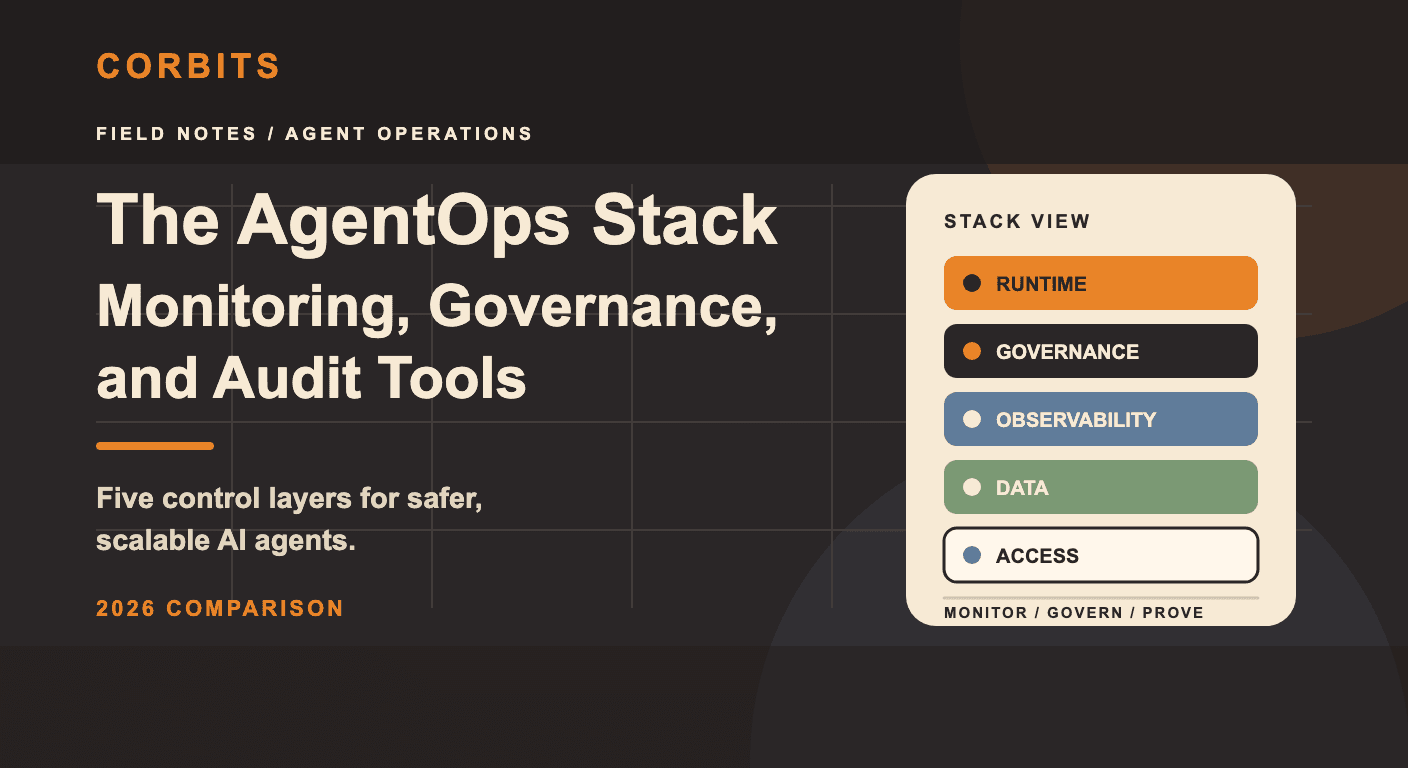
- Runtime sandboxing prevents an agent from reaching resources outside its approved boundary.
- Data governance limits access to sensitive information and records how that data is used.
- Observability explains why an agent made a decision and where a workflow failed.
- Identity and adaptive access control evaluate every action in context.
- Protocol-level governance connects policy and evidence across agents and frameworks.
Together, these layers create an AgentOps stack that is greater than the sum of its parts. The goal is to connect them through a governance layer that grows with the deployment.
That is where Interchange fits in. It works alongside existing frameworks and provides centralized governance, visibility, compliance evidence, and federation at the protocol layer.
As agent teams grow, governance should grow with them, not force organizations to rebuild the stack they already invested in.
Ready to build your AgentOps strategy? We are here to help.
See your agents, govern what they do, and prove it to anyone who asks.