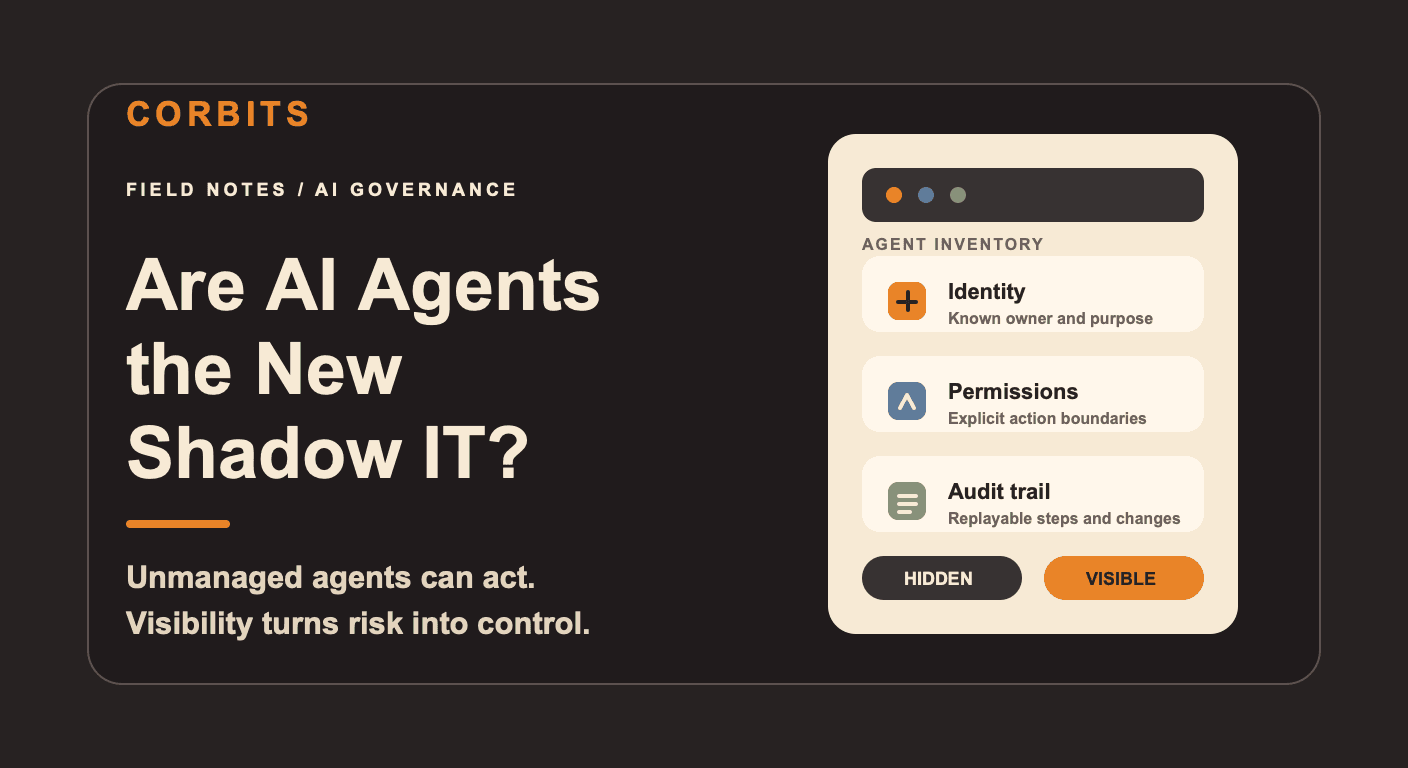
Are AI Agents the New Shadow IT?
AI agents create a new kind of shadow IT: unmanaged systems that can act across tools, spend money, and change records. Here's how visibility, identity, and auditability reduce the risk.
- AI Agents
- Shadow IT
- AI Governance
- Agent Operations
"Shadow IT." The name sounds vaguely ominous.
In reality, it's something quite mundane. Shadow IT is the use of devices, software, applications, or cloud services by employees without the knowledge or approval of their company's IT department.
It's also something every organization has had to deal with for decades. Every major wave of technology creates a new version of it. For instance, it happened years ago with the Internet of Things, or IoT.
The rise of IoT introduced smart TVs, printers, fridges, thermostats, and more, all connected to the Internet and flooding into home offices and workplaces. Organizations often discovered they had numerous connected devices they didn't know existed, which quickly became a security issue.
But the problem wasn't the IoT devices themselves. It was visibility. IT couldn't secure what it didn't know was there.
Watch the companion video:
The AI Version of Shadow IT
For years, shadow IT has mostly meant that there is unmanaged data somewhere.
A sales team might be running their pipeline from a private spreadsheet. An old browser extension set up by a long-gone employee still has access to everyone's email. Someone in marketing bought SaaS tools on their personal credit card and didn't let anyone know.
Today, with agentic AI, the stakes are even higher, because the AI version of shadow IT goes beyond unmanaged data. It involves unmanaged agentic systems making decisions on their own. An unmonitored device can leak data, but an unmonitored agent can actually act on it.
For instance, an AI agent can access your CRM, send emails on your behalf, approve requests, call APIs, modify records across multiple systems, spend money, and initiate entire multi-step workflows with little to no human involvement or oversight. That makes the risk profile fundamentally different from traditional shadow IT.
Here's a closer look at how the shadow IT of the past compares to today's agentic version:
| Traditional Shadow IT | AI Agent Shadow IT |
|---|---|
| Stores information | Takes action |
| Mostly passive | Autonomous |
| Usually affects one workflow | Can impact multiple systems |
| Human initiates work | Agent initiates work |
| Limited permissions | Can accumulate broad permissions |
The underlying challenge, however, hasn't changed.
The Visibility Problem
Whether we're talking about an IoT device connected to the company network or an AI agent working autonomously behind the scenes, the crux of the issue is visibility.
The World Economic Forum reports that organizations today are rapidly accumulating non-human identities, or NHIs, as agentic AI adoption accelerates. These NHIs include AI agents, API keys, service accounts, and other machine identities that act on behalf of people and systems.
The problem is, these identities often reside in security blindspots. Safeguards that typically apply to humans may not even be in place. And in many cases, NHIs are proliferating faster than security teams can track them.
As the report points out, "You can't protect what you can't see."
So, if you're unable to answer questions like:
- How many AI agents do we have running right now?
- Who created them?
- What data and systems can they access?
- What specific actions are they taking?
- Who is responsible for them?
...then you're effectively flying blind.
The Solution: Governance, Not Guesswork
History shows us that employees will adopt useful technology whether the IT department formally approves it or not. And they generally do it with good intentions. They're trying to get their work done in the best way they know how.
Instead of restricting this technology or stifling innovation, the goal should be to make agentic AI adoption visible, manageable, and ultimately accountable.
That starts with governance. At the most basic level, a good governance framework involves two things:
1. Identity
Each AI agent needs a clearly defined identity, with a name as well as a designated owner who's accountable for its actions. It also needs explicit permissions that outline not only what it can do, but what it can never do, no matter how reasonable the request may seem.
2. Auditability
Every agent's actions must be fully auditable, through a step-by-step session replay of what it did and why it did it. And crucially, the agent must be prevented from going into the log and modifying it after the fact. You can't let it rewrite its own history.
Ultimately, these two elements enable organizations to deploy AI agents securely, which means they can also scale with confidence.
The Bottom Line
The term "shadow IT" sounds ominous for a reason. But that's only because shadows exist where light is blocked... and we all know scary things can happen in the dark.
When it comes to agentic AI, the organizations that come out ahead won't be the ones who are running the most agents. They'll be the ones that know exactly what every agent is doing at any given time, what it's allowed to do, and why.
In other words, the future belongs to those who bring their agents out of the shadows.
Ready to shine a light on your agent operations? We can help you gain the visibility you need.
See your agents, govern what they do, and prove it to anyone who asks.