Neoteams: How Human-AI Collaboration Actually Works
A practical guide to neoteams: how humans and AI agents divide work, collaborate, and govern shared workflows without losing judgment.
- Neoteams
- Human-AI Collaboration
- Agent Operations
- AI Strategy
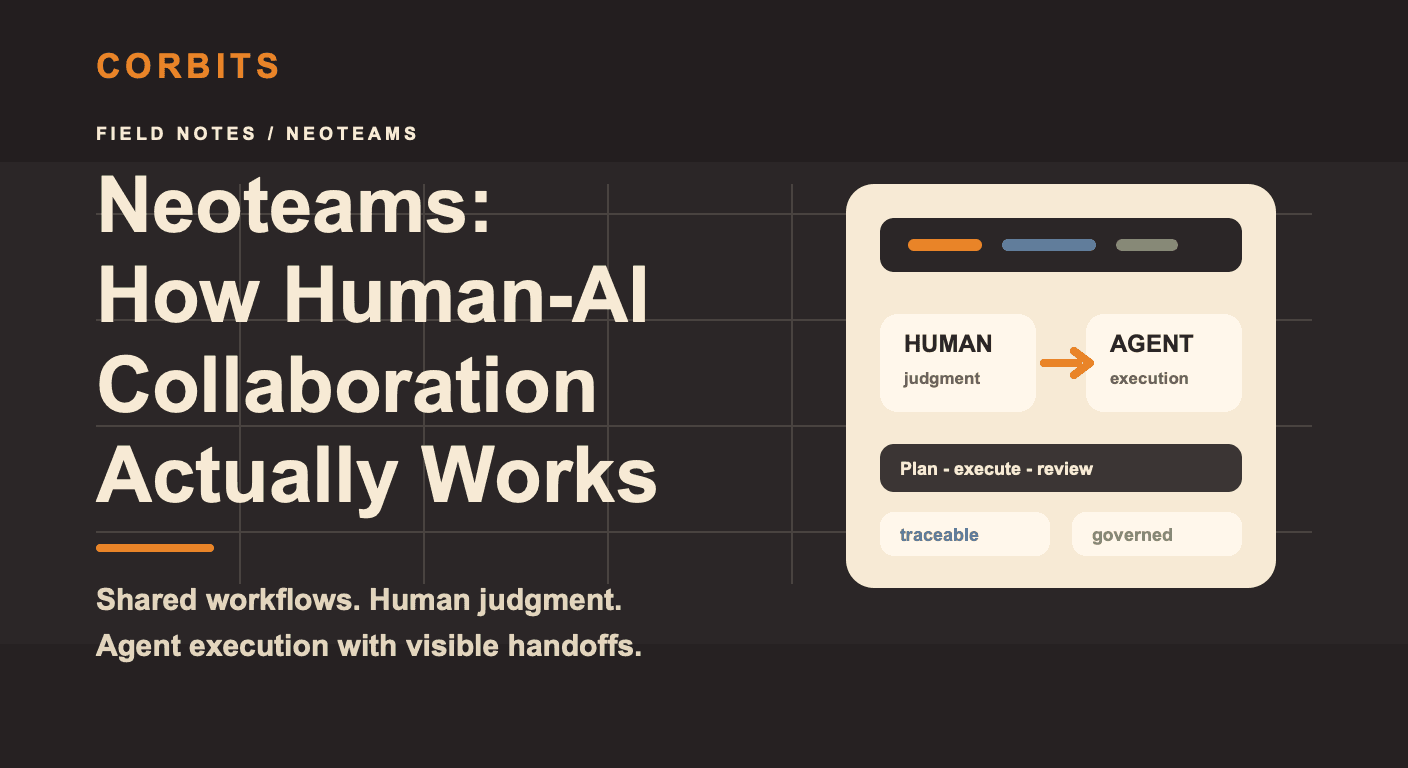
You might be surprised by the performance advantage of neoteams: small, integrated teams where humans and AI agents work side by side as collaborators rather than as a person using a tool.
When people work with AI agents rather than other humans, they become more productive. Researchers found that they send 25% more task-oriented messages and 18% fewer interpersonal messages. They delegate more and edit less.
And in the end, they produce 50% more output than their counterparts on a human-human team.
But statistics like these only tell you the outcome, not the process. What does collaboration between humans and AI agents actually look like? How do you set up these neoteams? What are the respective roles of human workers vs. AI agents? How do you deal with potential pitfalls?
Let's take a closer look.
AI as Teammate, Not Just a Tool
There's a difference between using AI as a tool and working with AI as a teammate. A tool does nothing until you pick it up. A teammate, on the other hand, observes the workspace, takes initiative, edits drafts, selects assets, sends messages, and makes decisions on their own.
When an AI agent can do much of what your human colleague can do, the human-AI pairing becomes collaborative. Your AI agent becomes a teammate.
But a teammate usually works inside the same environment as everyone else, in a place where collaboration is possible. Rather than being restricted to isolated chat sessions, effective AI teammates often need to operate in a shared workspace where humans and other agents can see their work, build on it, and leave feedback.
It might take some reframing of old mindsets to let go of the idea of AI as a simple tool. A neoteam is more than humans simply using AI to go faster. It's humans and AI agents dividing work and communicating about it, and ultimately producing something together.
How Work Gets Divided Between Humans and AI Agents
On a well-functioning neoteam, tasks are assigned based on natural strengths.
AI agents are basically highly educated robots. They don't have the same level of judgment, contextual understanding, or creative intuition that humans do, and they definitely don't have genuine emotional intelligence.
So, putting it broadly, humans take care of things like:
- Strategy and original, creative thinking
- Business logic and architecture
- Contextual analysis
- Complex problem-solving
- Subjective, nuanced judgment or ethical decision-making
- Client or patient relationship building
- Quality control and finalizing content
...while AI agents handle legwork such as:
- Data aggregation and processing
- Research and synthesis
- Repetitive brainstorming
- Syntax-heavy, boilerplate code generation
- Anomaly detection and proofreading
- Formatting and generating routine first drafts
- Executing repetitive tasks at scale
There's also the "jagged frontier" of AI capabilities to keep in mind. Neoteam research has found that AI can have unexpected strengths and weaknesses.
For example, in a large-scale study where human-AI teams and human-human teams produced thousands of real ads -- later tested on X with nearly 5 million impressions -- human-AI teams produced higher-quality text and more of it. Human-human teams produced higher quality images.
Some tasks fall clearly on the AI side of that jagged frontier. Others don't. Smart neoteam design means figuring out which is which and structuring the division of labor accordingly.
How Neoteam Collaboration Actually Works
Getting beyond general division of labor, you might wonder, "How do I even work with an AI agent? Who does what and when?"
Neoteams tend to fall into a handful of recurring collaboration patterns:
Worker + observer. The agent acts, and the human oversees in order to intervene when something looks wrong -- sometimes in real time, to catch mistakes before they compound.
Author + reviewer. The agent generates drafts, and the human approves... or doesn't. This works well for routine copy, briefs, status updates, customer replies -- or any task where reliable AI generation is easy.
Researcher + writer. The agent gathers raw material, and the human transforms it into finished output. Or the human submits material, the agent writes, and the human polishes.
Planner + executors. A human or agent writes the plan, and multiple agents or humans execute pieces of it in parallel. Attribution is crucial: you need to be able to trace each output back to its source when something requires correcting or revising.
Generator + director. Starting from a human's idea or first draft, the agent produces volume -- multiple options, variations, or drafts -- and the human makes taste and strategy decisions.
Autopilot + exception handler. The agent runs autonomously until it hits something outside its training, and then flags the human to take over.
Front of house + back of house. A human owns every external-facing interaction that requires trust or nuance, while both agents and humans handle the work product behind the scenes.
Designing a human + agent workflow requires choosing the right pattern for each task... and sometimes that means layering more than one.
Best Practices for Building a Neoteam
There are all sorts of challenging, unglamorous tasks involved in implementing a neoteam. Data engineering, stakeholder alignment, governance, workflow integration, and establishing continuous validation frameworks and robust API management. If you get the foundation wrong, no amount of prompt engineering will save you.
But beyond infrastructure, here are some best practices:
- Onboard your agents like new hires. A human teammate reads the handbook and onboarding documents and familiarizes themselves with the company before settling into their role. Your agents need the same opportunity.
- Codify tacit knowledge. Get explicit. AI agents require detail about things that humans can intuitively understand, like culture, values, direction, what's implicit and inferred.
- Know your frontier. Understand which tasks in your workflow fall on the AI's strong side and which don't. Divide labor accordingly.
- Think about fit. Agents can have personalities, too. Match the personality and posture of your AI agent to the humans it's working with, not just the task at hand.
- Keep human judgment in the loop. Design workflows where humans review, evaluate, and reshape AI outputs instead of simply accepting them. And exceptions, edge cases, one-offs, anything truly consequential... those are always for humans to handle.
- Measure what actually matters. Consider tracking things like decision accuracy, cognitive load reduction, task handoff efficiency, and even human skill levels independent of AI output.
- Protect human skill. Build in structured, unassisted practice without AI so the humans on your neoteam stay sharp. Bonus: this will also help prevent diversity collapse, in which overreliance on AI causes ideas and outputs across a team to become repetitive and/or similar.
A New Kind of Team
Every technological revolution changes our tools. The agentic AI revolution is changing our teammates.
This means the competitive advantage today belongs to organizations that know how to build hybrid neoteams where humans and AI agents amplify each other's strengths.
Think about it: AI has already changed how your teams work. The question now is whether you're ready to shape that change deliberately, or let it unfold by default rather than by design.
Not sure where to start? We're here to help.
See your agents, govern what they do, and prove it to anyone who asks.