
8 Open-Source Alternatives to Popular SaaS and AI Tools
Explore eight open-source and self-hosted alternatives to popular SaaS and AI tools, from Supabase and Nextcloud to Buzz, n8n, and AI assistants.
- Open Source
- Self-Hosting
- AI Tools
- Agent Operations
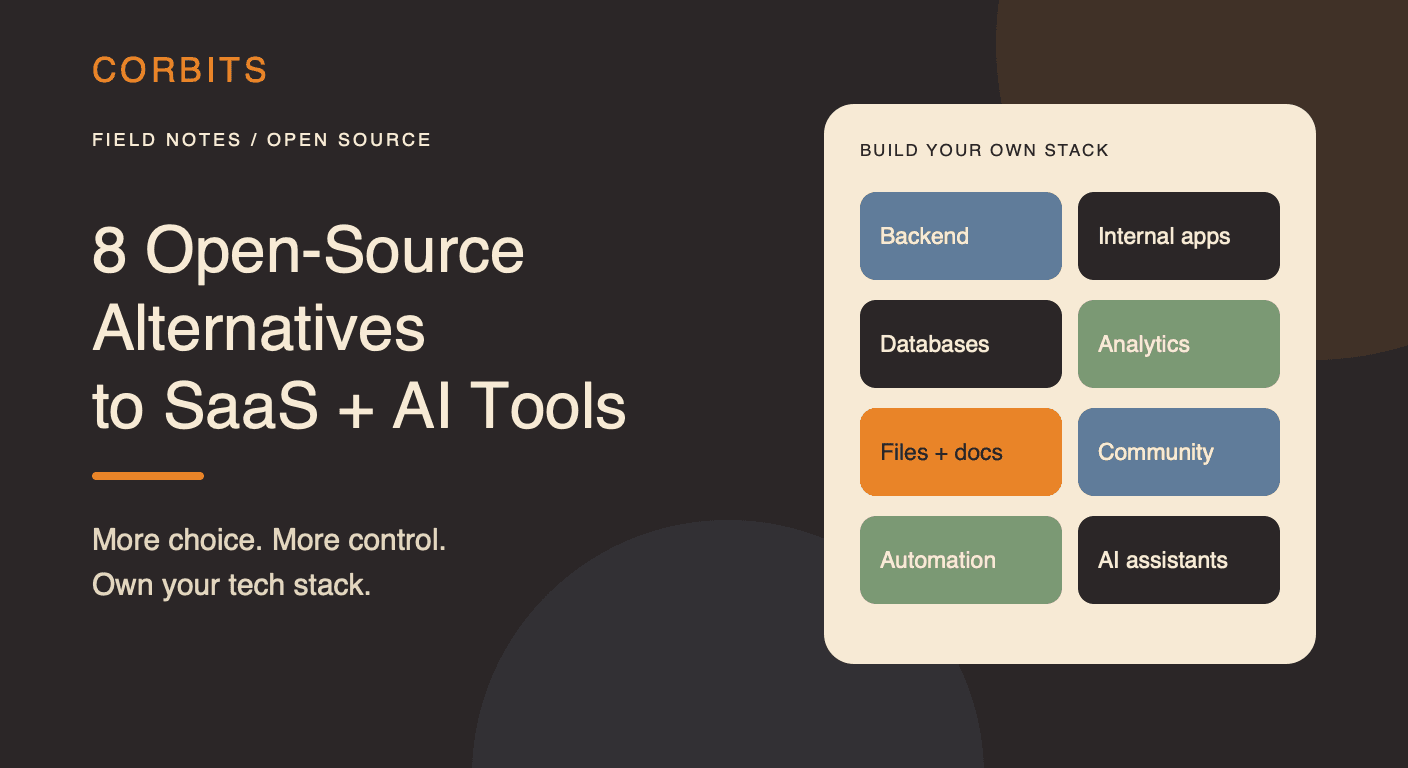
How much of your tech stack do you actually own?
Using proprietary Software-as-a-Service (SaaS) and AI tools is convenient. Someone else handles the servers, software updates, and much of the technical work behind the scenes, so you can just sign up and get straight to work.
But that convenience does have trade-offs. Cost is a big one: more expensive paid subscriptions and recurring fees. Then you have vendor lock-in. Usage caps. Limited control over where your data lives and how your tools operate.
Open-source and self-hosted alternatives hand more of that stack back to you. Whether you're looking for a replacement for Firebase, Dropbox, or Zapier, or exploring self-hosted AI agents, there are plenty of tools that put more choice and control in your hands.
Here are eight to consider. Most offer an open-source core; n8n is a source-available exception with license restrictions, which we explain below.
1. Supabase: Backend-as-a-Service Platform
An alternative to Google's Firebase, Supabase is an open-source Backend-as-a-Service (BaaS) platform built around PostgreSQL. It gives you a relational database with authentication, file storage, auto-generated APIs, and real-time functionality, so you get the backend infrastructure you need to build web and mobile applications.
Unlike Firebase's proprietary database model, Supabase runs on standard Postgres. That means you can use familiar SQL tools and move your data to other compatible environments. Use the Supabase Cloud hosted service or self-host the platform if you need greater control over your infrastructure.
Best for: Developers building web or mobile apps who want a ready-made backend without committing to a proprietary database.
2. Appsmith: Low-Code Internal App Builder
Appsmith is an open-source low-code platform for building internal business applications. These include admin panels, dashboards, approval processing, and CRUD (Create, Read, Update, Delete) tools.
You assemble the apps in a browser-based drag-and-drop UI builder that comes with numerous pre-built widgets, then connect them to your databases and APIs and add custom code with JavaScript if you need it.
An alternative to Retool, Appsmith saves teams from having to build custom interfaces from scratch every time. It can be used through Appsmith Cloud or deployed on a private server.
Best for: Teams that need custom internal tools but don't want to build every interface from the ground up.
3. Baserow: No-Code Database and App Builder
Baserow looks like a spreadsheet but works like a relational database. An alternative to Airtable, it's an open-source no-code database platform and application builder where you can organize data and build custom web apps, client portals, visual dashboards, and automated workflows right in your browser.
Choose between a fully managed cloud version with plan-based usage limits or self-host on your own infrastructure for more control over capacity. Your hardware and chosen features still determine practical limits. The core features in Baserow are free, but some capabilities like Kanban view and role-based access control (RBAC) cost extra; check the current plans and features.
Best for: Non-technical users looking to manage projects, content calendars, inventories, customer records, and other structured data in a familiar, spreadsheet-style interface.
4. PostHog: Product Analytics Platform
An open-source alternative to tools like Amplitude and Optimizely, PostHog is an all-in-one product and data analytics platform that helps teams understand how people interact with their websites and apps. It tracks user events and allows you to:
- Analyze page views and paths
- Optimize conversion funnels
- Measure retention and behavior
- Watch full session replays
- Manage feature flags
- Run A/B testing
PostHog can be self-hosted when you want more control over your analytics infrastructure. However, self-hosted deployments are officially unsupported, and paid-plan features are Cloud-only. The company recommends PostHog Cloud for most users, with a free tier that may cover smaller deployments.
Best for: Product and engineering teams who want to understand user behavior and measure feature adoption in order to make data-informed product decisions.
5. Nextcloud: Self-Hosted File Storage and Collaboration
Nextcloud is the "bring-your-own-server" alternative to Dropbox and Google Drive. It's an open-source collaboration platform for storing, syncing, and sharing files on your own server instead of a public cloud, so you maintain ownership and control over your data.
Nextcloud Hub brings together a suite of productivity and collaboration tools in one digital workspace:
- Talk for built-in audio calls, chat, and videoconferencing.
- Groupware for email, contacts, shared calendars, and other productivity features.
- Office for real-time collaboration across documents, spreadsheets, and presentations.
- Assistant for AI-powered assistance across the workspace, using local or hosted models.
- Flow for building low-code and no-code automations and streamlining workflows.
Accessible anywhere via web, desktop, and mobile apps, Nextcloud also offers community add-ons that expand the platform with new tools, games, and integrations.
Best for: Organizations that want a self-hosted collaboration platform with control over their files, communication, and data.
6. Buzz: Workspace Chat App for Humans and AI
Buzz is an open-source, self-hostable workspace app where AI agents become your teammates. It features channels and threads like Slack and Discord, with two notable differences: optional shared compute lets community members contribute local model inference, and AI agents are first-class participants in the community.
Inside Buzz, humans and agents work together in the same space, with shared context—and each agent gets its own identity and audit trail. For a detailed look at this new approach to human-agent collaboration, see the previous article and video walkthrough.
Best for: Teams experimenting with AI agents as full participants in their workspace.
7. n8n: Workflow Automation Platform
n8n is a low-code workflow automation platform that connects apps, APIs, services, and AI models through a node-based visual editor. You build automations by dragging and dropping nodes onto a canvas. Workflows start with a trigger event, such as a form submission, and then follow a sequence of steps to process data and execute tasks across your connected systems—such as automatically sending an email.
What sets n8n apart is its flexibility. Unlike Zapier, it's source-available and self-hostable. Its Sustainable Use License places restrictions on commercial redistribution and hosted offerings, so it is not open source under the usual unrestricted definition. On top of that, it:
- Supports a large integration library, plus custom API requests, webhooks, and community nodes.
- Manages complex workflows with branching and merging, multiple triggers, error handling, and custom JavaScript or Python code.
- Connects to AI models through dedicated nodes, custom API endpoints, and local LLMs via Ollama.
Best for: Technical teams building complex multi-step automations that integrate business applications and connect AI models and agents to external tools.
8. Hermes Agent and OpenClaw: Self-Hosted AI Assistants
Going beyond SaaS tools, Hermes Agent and OpenClaw are open-source self-hostable autonomous AI personal assistants that can run on your local machine or cloud server.
Both provide you with an "always-on" assistant, but they focus on slightly different things:
- Hermes Agent supports long-running tasks and reusable skills, with persistent memory and a learning loop for improving skills over time. It can run isolated agent profiles, has a built-in scheduler for background jobs, and uses tools like web browsers, terminals, and messaging platforms.
- OpenClaw uses a gateway to connect your chat-native agent to messaging apps like Discord, Telegram, Slack, and WhatsApp, so you can manage persistent conversations across multiple channels. Its modular skill system lets you add capabilities.
Hermes Agent and OpenClaw support multiple model providers, so you can choose hosted providers or configure local models.
Best for: Developers and enthusiasts who want an always-on AI assistant they can self-host and connect to the models and tools they choose.
Take Back Control of Your Tech Stack
Open-source and self-hosted tools give you more control over the systems your team relies on. It's good practice to think about things like where your tools run, how they connect, and what happens to your data. And as AI increasingly becomes part of everyday work, it's crucial to have visibility into what it's doing and the ability to define what it's allowed to do.
You don't need to self-host everything. But carefully choosing where you want that control can give you a technology stack that's easier to understand and govern.
Own your tech stack before it owns you. We can help.
See your agents, govern what they do, and prove it to anyone who asks.