AI Business Automation Tools: Why Agent Governance Is the Missing Piece
AI business automation now spreads through workflow builders, embedded productivity tools, and custom agents. Governance is what keeps those systems visible, accountable, and safe to scale.
- AI Governance
- Business Automation
- Agent Operations
- AI Agents
Businesses have more ways than ever to automate work with AI.
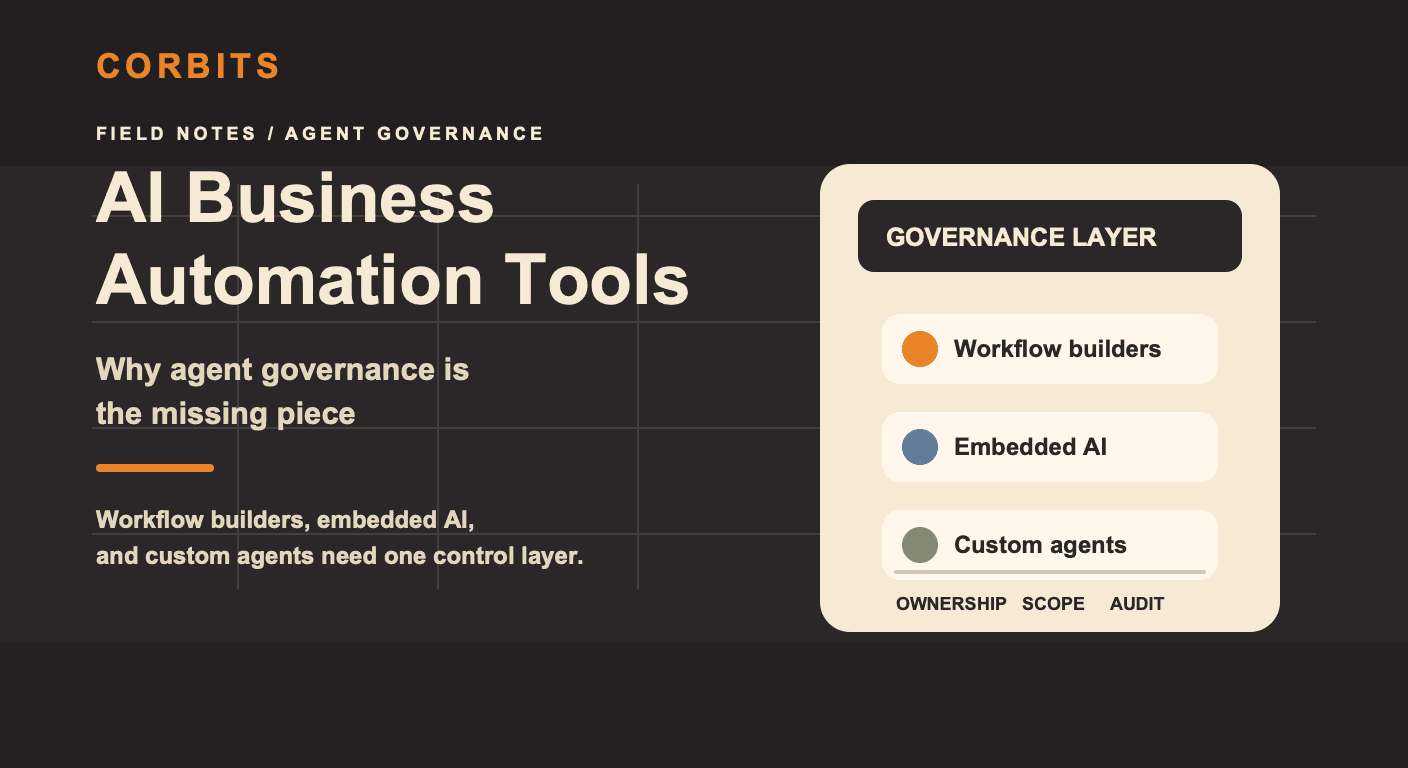
Workflow builders like Zapier, Make, and n8n now incorporate AI agents. Productivity suites like Microsoft 365 and Google Workspace are embedding AI directly into everyday work. Tools like OpenAI Agent Builder and Claude Code make it easy to create and deploy custom AI agents for specialized tasks.
Right there you have three different ways AI can spread through an organization, and three different ways visibility can be lost. Here is how each avenue creates a blind spot of its own.
1. Workflow builders bypass traditional review processes
Zapier, Make, and n8n have been around for years. They were built to be easy. All you have to do is connect an app and ship a workflow.
Adding AI agents into the mix did not make these platforms harder to use, but it did change their capabilities. What used to be simple rule-based automation can now make judgment calls, invoke tools, interact with business applications, and plan and execute multi-step tasks with little to no human involvement.
The problem is, these agentic workflows do not necessarily look like systems that need governance. They are deployed just as seamlessly as any other workflow.
But once they are reading emails, calling APIs, and making decisions on their own, suddenly you have powerful agentic automation on your hands that can reach production without the visibility and ongoing oversight it needs.
2. Embedded AI is invisible because it looks like a feature, not a system
Productivity suites like Microsoft 365 and Google Workspace are increasingly embedding AI into the apps that employees already use every day.
Copilot can take action across the Microsoft ecosystem, while Gemini Gems and Workspace Studio offer a no-code way to build specialized AI assistants and agentic workflows without ever leaving Google Workspace.
Yet these capabilities can feel like just another feature in Outlook, Word, Gmail, and Docs. They are easy to adopt, and they live inside applications you already know and trust.
The challenge is not that these tools are hidden. Everyone knows Copilot and Gems exist. The real challenge is that they are so deeply integrated into everyday work that organizations often fail to evaluate them as agents in their own right.
3. Custom agents proliferate without centralized oversight
Today just about anyone can build an AI agent. Platforms like OpenAI Agent Builder and Claude Code have dramatically lowered the barrier to entry.
And that is a good thing. Organizations can take advantage of the increasing accessibility of AI, with agents tailored to their own processes and data and a simplified path to deployment.
But every custom agent has its own instructions, permissions, tools, knowledge sources, and integrations. One agent might access a CRM. Another might query an internal database. A third might make actual purchases online. Multiply that across a growing library of agents, and now you have a whole new operational problem: keeping track of each one.
Plus, when any employee can create a custom AI agent for their own use at work, there is the risk that they will do so without the knowledge of the IT department. It is the agentic version of shadow IT.
Whether sanctioned or unsanctioned, as the number of agents within an organization grows, so does the challenge of understanding exactly what they are doing, and why.
The missing piece is governance
Workflow builders make AI easy to deploy. Productivity suites make AI easy to overlook. Agent builders make AI easy to multiply.
But governance is what makes AI safe to scale.
Effective agent governance means being able to answer five simple questions:
- What AI agents are running?
- Who owns them?
- Where do they act and on what information?
- Why did they make a particular decision?
- How can their behavior be reviewed or audited?
Without those answers, there is no visibility or oversight of your agent operations, and no accountability.
Organizations today are not just adopting a single AI platform. They are assembling an ecosystem of tools that are modular, interconnected, and distributed across teams, and governance has to span all of them.
But that is not something you tack on at the end. Governance must be a core part of every deployment, not an afterthought.
This is exactly the challenge that AgentOps is designed to solve, so you never have to wonder where your agents are, what they are doing, or whether they are operating as intended.
Building AI agents is easy. Building trust in them is harder. We are here to help.
See your agents, govern what they do, and prove it to anyone who asks.