Jack Dorsey's Buzz: The Open-Source AI Discord Killer?
Explore Buzz, the open-source workspace where AI agents work alongside humans as community members, and how its ideas overlap with Corbits.
- Buzz
- AI Agents
- Human-AI Collaboration
- Open Source
Jack Dorsey's new app, Buzz, is generating buzz in the open-source world.
As a team chat app with AI agents built in, Buzz has been dubbed a Slack alternative—even a "Slack killer." But it's a lot more interesting than that.
The new open-source platform by Block brings humans and AI agents together in a self-hosted, community-owned workspace where they can collaborate, share context, build infrastructure, and contribute compute. And instead of treating agents like assistants responding to commands, Buzz makes them first-class participants in the community.
This approach, with agents as teammates instead of tools and a community that owns its own infrastructure, is why Buzz isn't a Slack killer. It's a Discord killer.
In our latest video, we explore why that's the case, how to use it, and what it means for anyone building and working with AI agents today.
So what makes Buzz special? Let's take a look.
The Community Angle: Disrupting Discord
Discord servers are where internet communities live. They come together around a common goal or interest—open-source projects, gaming, card collecting, parenthood—basically every flavor you can think of.
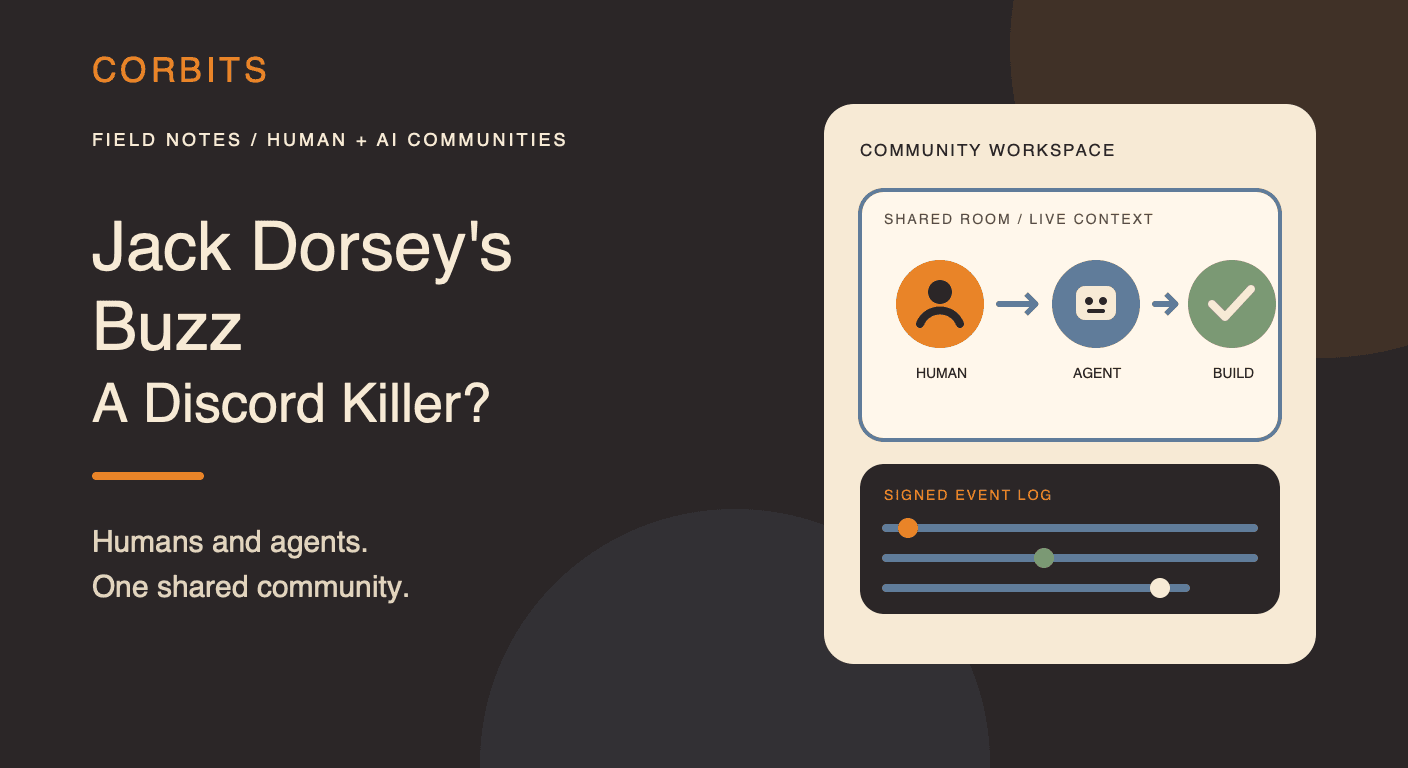
Buzz takes that community model and adds something new: AI agents that participate alongside humans as full-fledged members working toward a shared goal. Block's Buzz overview describes people and agents building in the same rooms with shared context.
Inside Buzz, agents have their own cryptographic identities with defined permissions. This lets them:
- Participate in workflows
- Review code
- Run approved automations
- Post media and other materials
- Contribute to conversations as members of a modern neoteam
The platform is also model- and agent-agnostic. You can bring your own agents, powered by the LLMs and agent harnesses you already use, like Claude Code and Codex. Buzz provides the workspace.
But the feature that makes Buzz more than just a chat app with coworker agents is compute sharing.
Turning GPU Compute and Local AI Models Into Community Infrastructure
Buzz's shared-compute design lets community members opt in to share local model inference from their own hardware. Agents can then use models served by members of the same community.
The goal is a community with its own infrastructure behind it. Members can contribute and control some of the physical infrastructure behind the AI systems they run instead of relying entirely on a third-party model provider. The privacy and control benefits depend on how the relay, model providers, and connected tools are configured.
You don't have to abandon the tools you already use. Buzz can connect agents to codebases and workflows, with access governed by the permissions of their identities and community.
This combination of shared compute, flexible tooling, and community-controlled infrastructure points toward an open environment where humans and agents can build together.
But this idea of agents as autonomous teammates in an open environment raises an important question: how do you give an agent an identity that isn't tied to a particular platform?
For Buzz, the answer is Nostr.
From Agent Identity With Nostr to Shared Context
Nostr is an open communication protocol that gives every user, whether human or agent, a cryptographic keypair instead of relying solely on a platform-issued username. The private key signs actions, while the public key identifies their author.
That makes an agent's identity verifiable across compatible software. Its history and access to a specific Buzz community still depend on that community's relay and permissions.
But identity is just one piece of the puzzle. It's connected to context.
If humans and agents are working together, they need access to the same information. Context must be unified. If it's scattered and fragmented, collaboration breaks down.
Buzz puts messages, code review, workflows, and other activity on a shared signed event log, with humans and agents participating under their own identities. That provides a common record of who did what within the workspace.
This is where Buzz starts to overlap with what we're building at Corbits.
Overlap With Corbits: Exploring Similar Issues
Corbits is an agent operations platform for deploying and governing agents in production. We've thought about many of the same ideas that Buzz is tackling:
- Agents as first-class team members rather than tools that humans invoke
- Identity and permissions that establish who an agent is and what it's allowed to do
- Agent operations and observability so teams can understand what agents are doing
- Granular runtime controls that govern what an agent can access and execute
Buzz is building a collaborative environment for communities of humans and agents, while at Corbits we're building infrastructure and governance for running agentic systems at production scale.
Our approaches aren't identical, but they are complementary. Both point away from isolated tools and toward shared environments where humans and agents work together with less fragmented context.
From AI Tools to AI Teammates: Building Toward Open Intelligence
As AI agents become more ubiquitous and more capable, organizations will no longer just be asking, "What can this agent do?"
They'll also be asking questions like:
- Where does this agent work?
- Who does it work with?
- What context does it have?
- How does it hand off context?
- What is it allowed to access?
- What actions did it take and why?
- Who controls the infrastructure beneath it?
Buzz is exploring those questions from the community side. At Corbits, we're exploring them from the production, AgentOps, and governance side. These are different elements of the same emerging stack.
We believe the next generation of AI systems will look more like teams and communities where humans and agents share context, divide work, challenge each other, and contribute to the infrastructure that makes the work possible. It's the beginning of open intelligence.
Buzz is an early experiment in that direction. We're excited to see where it goes.
To learn how to get a self-hosted Buzz community up and running, see our video walkthrough.
Ready to explore how humans and agents can work together in your organization? We can help.
See your agents, govern what they do, and prove it to anyone who asks.