
Can AI Agents Manage Their Own Budgets? What Actually Works in Practice
Can AI agents safely manage their own budgets? Learn where agents can optimize spending and why infrastructure must enforce their limits.
- AI Agent Budgets
- AI Cost Management
- AI Governance
- Agent Operations
We can all agree that AI agents need a budget.
But can you put agents in charge of their own budgets? That's a whole other ball game.
AI agents are increasingly capable of making decisions about resource allocation, purchases, infrastructure, marketing spend, and more. But there's a difference between an agent optimizing within a budget and an agent being responsible for enforcing its own budget.
Let's break down where that authority should lie.
What Does It Mean for an AI Agent to Manage a Budget?
"Managing a budget" can encompass several different things.
For instance, an agent might:
- Monitor how much money it has spent.
- Optimize budget by choosing cheaper ways to accomplish a task.
- Allocate a predefined pool of money across campaigns or infrastructure.
- Transact on behalf of a user or organization.
- Determine whether a particular expenditure is permitted.
The first three actions are relatively low risk, while the last two require much stronger controls. Let's start with the low-risk end.
In our previous blog post on how to set an AI agent budget, we divided agent spending into two categories: transactional and operational. Each has its own risks and controls.
But there are certain areas where agents can already make useful, cost-conscious decisions on their own.
Where Agents Can Actually Optimize Spending
Four areas stand out in particular:
Operational spend. Agents can adjust resource allocation based on demand, scaling up or down or switching workloads to more cost-effective infrastructure.
Model and API costs. Frontier model overuse can drive costs up quickly. Dynamic model routing allows simple tasks to go to smaller, cheaper AI models while complex reasoning is reserved for more advanced models when the cost is justified.
Context and tool usage. Long-running agents can accumulate enormous amounts of context, resulting in prompt bloat. Compacting context, reducing unnecessary tool calls, setting hard token quotas, and implementing rate limits can all help keep those costs under control.
Marketing and business budgets. Agents can identify where resources are producing the best results. That means they can analyze performance in order to reallocate predefined budgets and optimize them against predetermined objectives.
The catch? In all of these areas, the agent is simply deciding how to use the resources it's been authorized to manage. That's totally different from it having the authority to define and enforce its own limits.
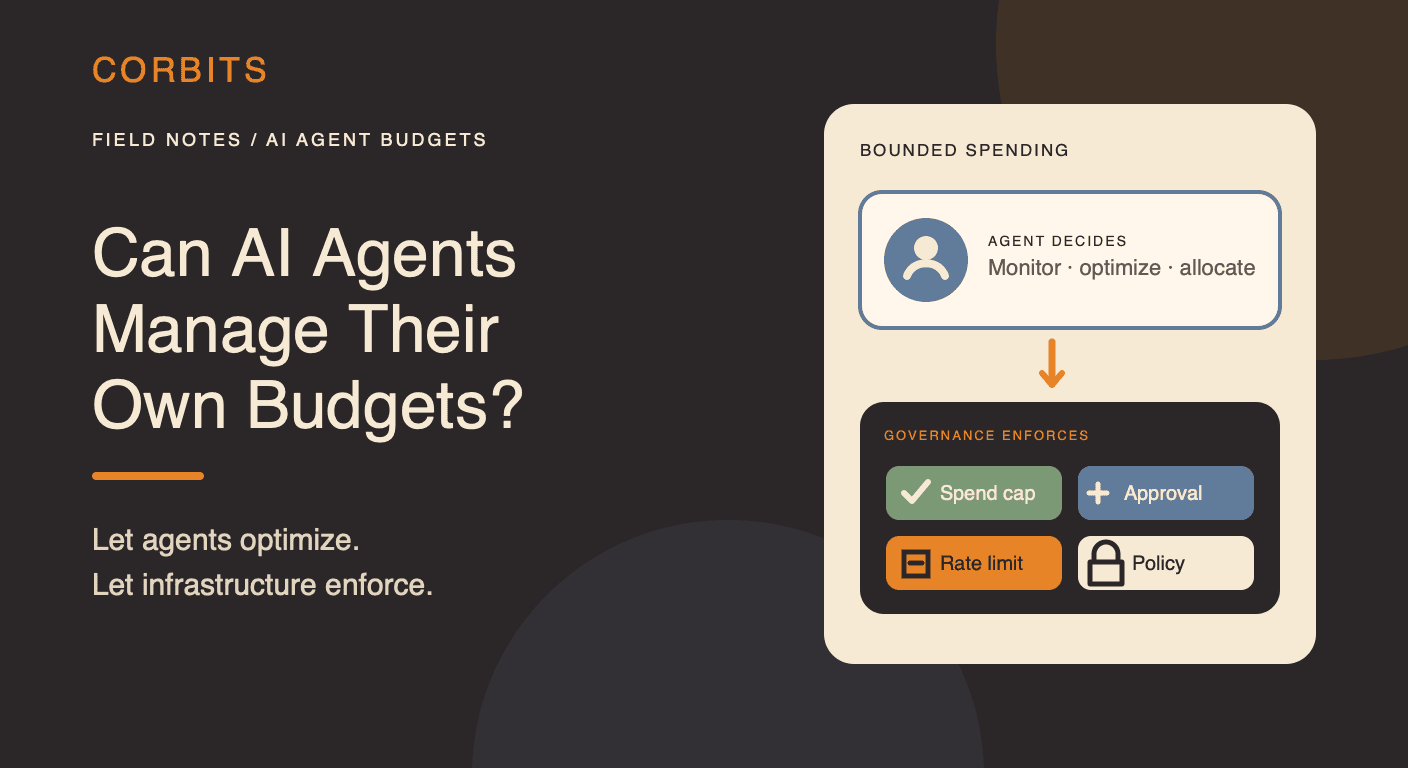
Let Agents Optimize. Let Infrastructure Enforce.
The safest and most effective approach is to separate decision-making from enforcement.
After all, agents are designed to act on our behalf. Given relevant information and cost awareness, they have to be able to make money-related decisions on their own.
But at the same time, hard limits must be implemented in such a way that they can't be overridden.
So, at the agent level, you can provide:
- A predefined token or dollar budget per task or session
- Visibility into how much of that budget remains at any given time
- Different cost tiers for models and tools
- Instructions to prioritize cost-efficient execution
Meanwhile, external controls should enforce things like:
- Per-agent and per-workflow spending caps
- Token and API key quotas
- Rate and transaction limits
- Approved merchants and payment categories
- Human approval for specific cases
A real-time governance layer makes it possible to evaluate these policies before an action even happens. That way, the system can block or terminate the action in the moment, rather than leaving it to be discovered after the fact, when it's too late to do anything about it.
Authorization Requires Context
A spending limit doesn't exist in isolation. There's context to consider.
Let's say an agent decides it wants to make an API call that will cost $10. A real-time governance layer has to go a lot deeper than just asking, "Has this agent exceeded its budget?" and then barreling forward if the answer is "no."
That is, it needs enough context to determine whether the specific action can go ahead.
So the governance layer should be able to answer questions like:
- Which agent is making the request?
- Who owns or authorized that agent?
- What task is it executing?
- What budget is it operating under?
- How much has it already spent?
- Is the action allowed under applicable policies?
- Does it require human approval?
The request then proceeds only after these checks pass.
This process results in a crucial separation of responsibilities: the agent decides what it wants to do, and the governance layer decides whether it's allowed to do it.
Autonomy Needs Enforceable Boundaries
The bottom line is, letting an agent freely manage its own budget is risky. Without enforceable boundaries, it could redefine its workflow, grant itself additional permissions, or override its spending limits by coming up with some justification to do so. Basically, it could start treating itself like the boss.
The safer approach is to run an agent as part of a declared graph of steps, or a strictly governed workflow, with defined steps, permissions, and limits. The agent still has room to make decisions within those parameters, but it can't operate outside its predefined scope.
This is where governance and agent orchestration come together. Multi-step orchestration gives agents a defined path to operate within, while governance ensures they stay within the boundaries of that path.
There's another benefit to well-governed orchestration: every run leaves a durable record of what the agent did, when it did it, and under which policies it was operating. The result is autonomous execution that's bounded and auditable—which is exactly what you want when you're dealing with agents spending money.
Autonomy Without Unlimited Authority
So, can AI agents manage their own budgets? In a way, yes—as long as "manage" means optimize instead of authorize.
An agent can watch its spending, choose cheaper paths, reallocate resources, abide by token quotas, and so on. What it should never do is be the one who decides where its own limits lie. That authority has to reside outside the agent, in infrastructure that doesn't bend to a well-reasoned argument.
The reward is simple: an autonomous system you can actually trust.
Want to give your agents more autonomy without giving up control? We can help.
See your agents, govern what they do, and prove it to anyone who asks.