
AI Agent Orchestration vs. Workflows: What's the Difference?
Learn how AI agent orchestration combines structured workflows with autonomous decision-making to create governed, durable, and auditable multi-agent systems.
- Agent Orchestration
- Agentic Workflows
- Multi-Agent Systems
- AI Governance
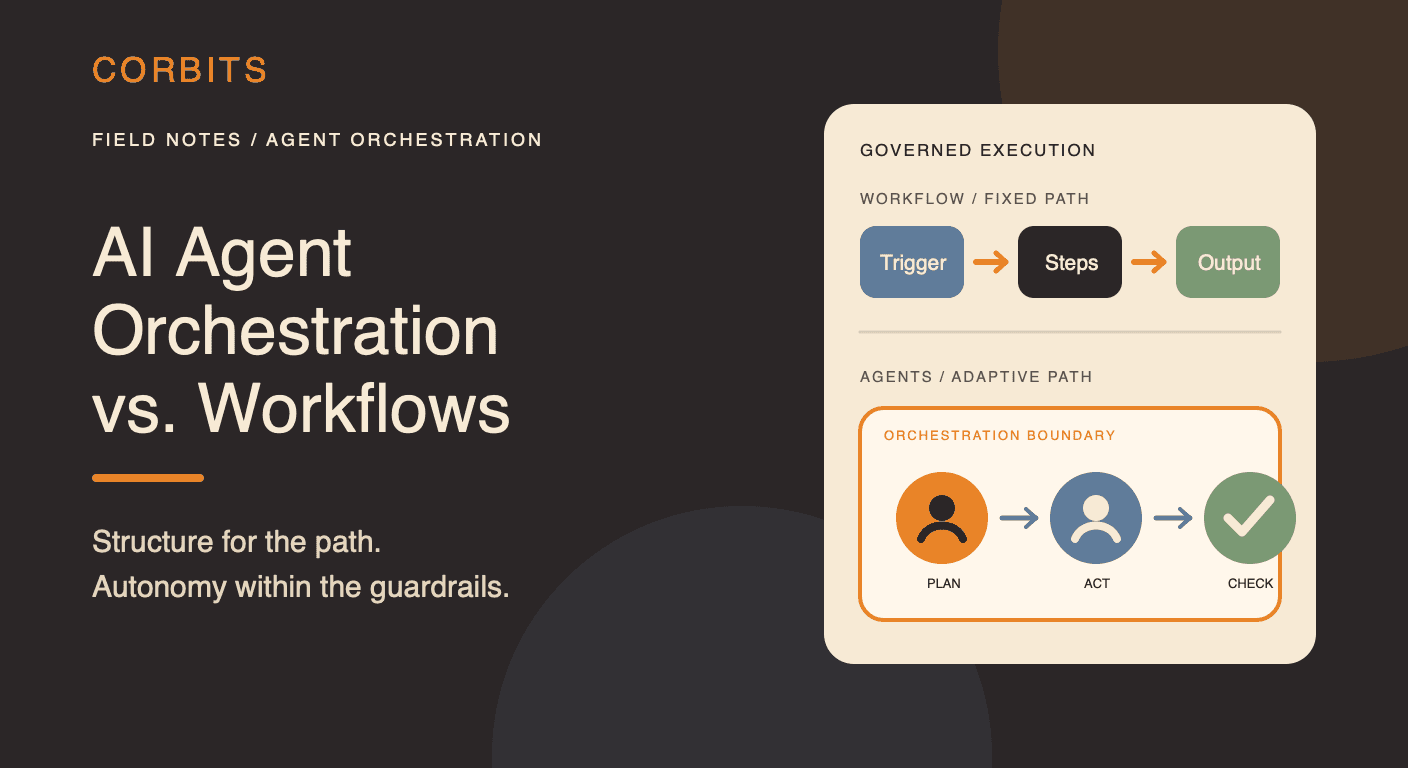
For years, workflows have been the backbone of business automation.
Traditionally, workflows involve a fixed sequence of steps, hard-coded to occur one after the other. There's a trigger and then a series of actions. The path is predefined, and each step behaves predictably.
Then autonomous AI agents came along and upended that equation.
In this post, we'll look at how agents are changing the nature of workflows, where an orchestration layer fits in, and why it's necessary.
Watch the companion video:
From Deterministic Workflows to Agentic Workflows
Deterministic workflows are like assembly lines. Identical inputs produce identical outputs, as the system simply follows the path that was designed for it.
That's useful when the process is meant to happen the exact same way each time. But many real-world tasks aren't. Like contract negotiations, for instance. Given unique requests from clients, an autonomous AI agent needs to be able to reason on its own rather than follow a rigid flowchart.
So, given a specific goal, a deterministic workflow says, "Do A, then B, then C."
Conversely, an agentic workflow goes like this:
- Determine what needs to happen in order to reach the goal.
- Take action.
- Evaluate the result.
- Decide what to do next.
The agentic approach is flexible, and because of that flexibility, it's also much harder to control. And things get a lot more complicated when more AI agents are involved.
How Multi-Agent Workflows Create Coordination Challenges
For simple tasks, you might have a single AI agent that reasons and uses tools autonomously.
But more complex workflows require specialized capabilities that a single agent couldn't reliably deliver on its own. That's where multi-agent systems come into play and introduce new challenges, such as:
- How does one agent know what another agent has already accomplished?
- Who decides which agent or sub-agent should handle the next task?
- What information should be handed off between them?
- What happens when failures occur partway through a workflow?
With a single agent, for the most part you can focus on whether it successfully completed its assigned task. But with multiple agents, you also have to worry about whether they're working together correctly.
That's the problem agent orchestration solves.
Why Multi-Agent Workflows Need Orchestration
Agent orchestration is the coordination layer that manages how multiple AI agents work together as a single system to complete complex tasks.
Put simply, the coordination layer is like a traffic controller. It determines which agent handles a task, how work moves between agents, what happens when there's a roadblock, and how the whole system stays on track.
Without that coordination, things can get dicey with multiple agents. Duplicated work, conflicting outputs with no tiebreaker, single points of failure without a recovery path, getting stuck in loops. It's a lot.
A good orchestration system heads all of that off. You get:
- Specialized agents that can each focus on what they do best.
- Work distributed across parallel agents, allowing for greater processing volume.
- Specific protocols for agent handoffs, interruptions, and failed tasks.
- Each agent's access restricted to specific data and tools, ensuring they operate only within their authorized scope.
However, simple coordination alone isn't enough for enterprise AI. The more agents you deploy, and the more autonomy they have, the more important it becomes to establish boundaries around what they can do.
Why Orchestration Needs to Set Boundaries
An agent loop is the cycle an AI agent runs through to complete a task. It iterates through this cycle -- perceive, plan, act, observe, repeat -- until it reaches a goal or a stopping condition.
Now imagine an open-ended agent loop. That's where an agent can continue taking actions until it decides that its task is complete. It's flexible and unbounded.
For a simple task, that flexibility might be useful. But for an enterprise workflow that runs for hours, involving multiple tools, external systems, and handoffs across agents, plus the need to survive processes dying partway through, an open-ended agent loop creates some obvious problems.
For instance, how many times can an agent retry a task? What happens if it gets stuck?
If the process crashes, where and how does it resume? If an action has already taken place, how do you prevent the system from performing that action again when the workflow restarts?
This is where orchestration and governance intersect. Autonomous systems need room to make decisions, but they also need clearly defined boundaries around their execution.
The solution? Running a workflow as a declared graph of steps rather than an open-ended agent loop.
How Durable, Resumable Agentic Workflows Improve Reliability
Multi-step orchestration is the key. Declaring the graph up front makes each run -- a single execution of the workflow -- bounded and recoverable.
A few benefits of this approach:
- Known limits. The system maps steps and computes permissions before execution even starts.
- No endless loops. Each loop has a defined maximum number of iterations to prevent a rework loop from spinning past this ceiling.
- Saved checkpoints. Every action is logged as it happens, saving the current system state and making failures recoverable.
- Resumable execution. If a step breaks, you fix the error and restart from that exact node.
- No wasted work. You don't need to rerun successful steps or risk duplicating already-committed effects.
Agents can still make decisions within the workflow, but they're constrained. It's freedom with guardrails.
On top of that, each long multi-step run leaves a durable record. You can check progress, trace every step, restart without repeating work, and maintain a complete audit trail.
That's agent governance. After all, you can't govern what you can't see, leaving the door cracked for Shadow IT.
Agent Orchestration and Governance: The Case for Governed Autonomy
Think of it this way: Workflows set the path. Agents navigate the path. Orchestration coordinates them, and governance keeps the whole system under control.
Not all approaches provide the same level of control. Are we talking about an open-ended agent loop that finds its edges in production, or a declared, governed workflow that's bounded and auditable from beginning to end?
For enterprise AI, the latter is often the only option.
Ready to bring order to your agents? We can help.
See your agents, govern what they do, and prove it to anyone who asks.