
AI Agent Budgeting: Set Spend Limits Before You Deploy
Set practical AI agent budgets before deployment. Learn to cap transactional and operational spend, track usage, and prevent unexpected API bills.
- AI Agents
- Agent Operations
- AI Cost Management
- AI Governance
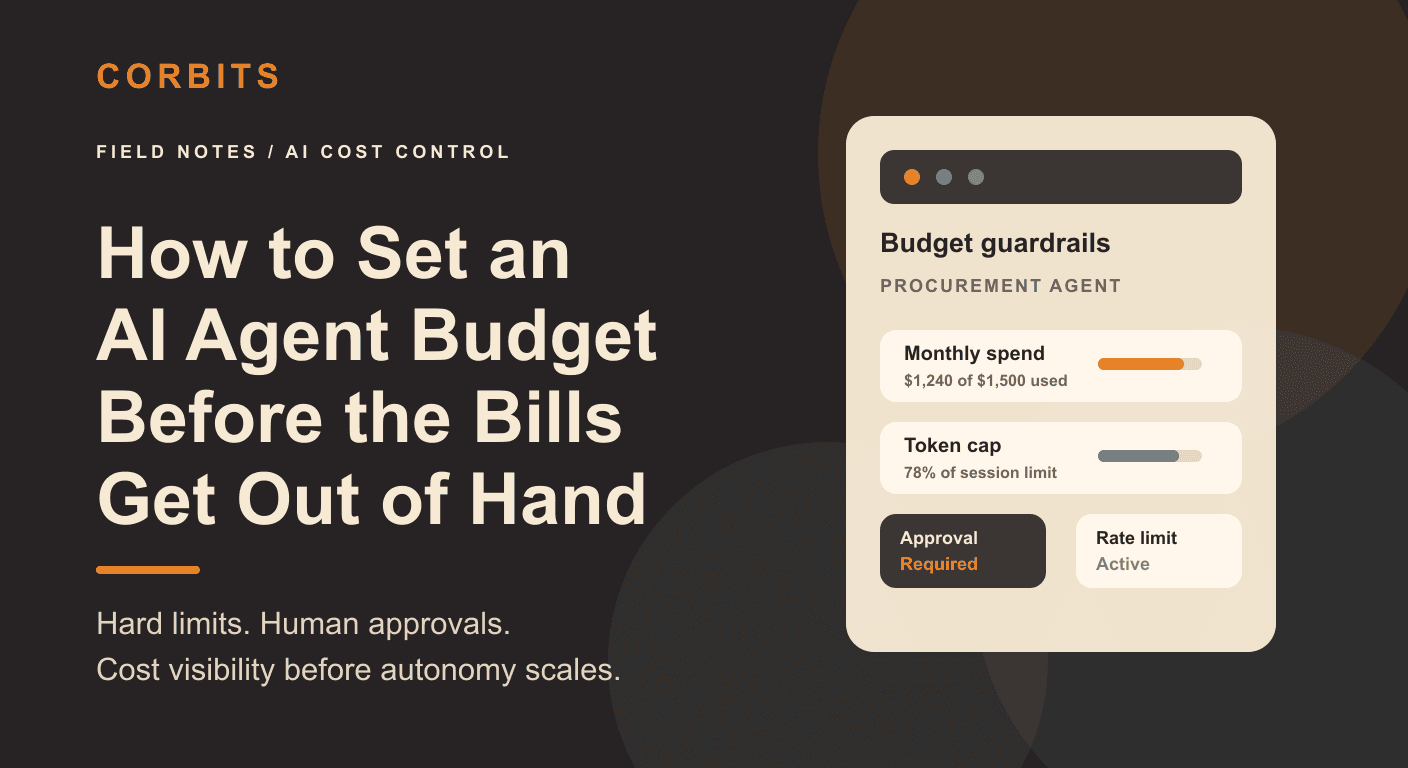
You wouldn't give a new hire a company credit card and let them run wild. Why would you do the same for an AI agent?
Modern AI agents can run 24/7 and buy office supplies, place vendor orders, book travel, and provision cloud infrastructure. They do it without a human in the loop, which is the whole point. That reality means you have to put spending controls in place.
In other words, your AI agents need a budget. AI agent cost management starts before you deploy, not after your first surprise invoice.
But what actually makes agents costly? And how do you cap their spending?
What Drives AI Agent Costs
With AI agents, there are two kinds of spending you need to control. The first is transactional.
When agents are given the ability to transact on behalf of users or organizations, they spend real money. Transactional costs include the kinds of purchases mentioned above, like buying software and booking flights.
However, even when an agent isn't buying anything, it can still generate a surprisingly large bill. This is due to the second type of spending: operational.
AI agents consume small units of text data called "tokens" whenever they read data, search the web, or run code. These tokens translate directly into API costs, and a single complex task can rack up significant charges. Setting a token budget per agent and enforcing it is one of the most effective controls you have.
Gartner reports that agentic models use 5-30x more tokens per task than a standard AI chatbot. There are multiple reasons for that.
First, agents don't just complete simple requests. They execute multi-step workflows that can last for hours. Agents also create sub-agents for specialized tasks. Each sub-agent is a new inference cycle, and each cycle adds charges. And context windows grow as sessions go on, so more context means more tokens per call.
So here are the pitfalls in both types of spending.
Common AI Agent Budgeting Mistakes (and How to Avoid Them)
Transactional Costs: What Your Agents Buy
An agent that can make purchases on its own needs the same controls you'd put on a new employee's corporate card, or maybe even stricter ones, because AI agents lack human judgment.
The following are some common failure points when it comes to transactional costs:
- Open-ended payment credentials. If an agent has access to a general-purpose card without any merchant restrictions, it can buy from any vendor in any amount.
- No approval chain for high-value transactions. Without human review, agents may be able to execute costly purchases or commitments that exceed their intended authority.
- Agent sprawl. One AI agent can be copied for new use cases, each copy carrying purchasing authority and token access, with no clear oversight.
Here's what you can do about it:
- Issue scoped, single-use payment credentials with merchant and dollar limits baked in.
- Restrict each agent to approved merchants and categories.
- Require human approval for any spending above thresholds you define, such as for new commitments and first-time vendor payments, transactions above a set dollar amount, or anything involving infrastructure changes.
- Assign clear ownership for each agent, so a human owner is always accountable for its spending and output. Define how often reviews should happen.
Operational Costs: Your API Bill
You don't want to deal with an unexpectedly huge API bill at the end of the month! But that can happen with these operational failure points:
- Frontier model overuse. Not every task needs your most capable and most expensive model.
- Looping agents. Sometimes an agentic AI workflow will repeatedly execute the same or similar actions without deciding it's done, driving up token and API costs. This can be the result of poorly defined goals, faulty reasoning, tool failures, multi-agent feedback loops, or even software bugs.
- Prompt bloat. Repeatedly sending large amounts of context back to the model causes each inference to consume more tokens than necessary.
- Uncapped sub-agent spawning. Costs can spiral out of control when each sub-agent inherits the full prompt context, starts its own session, and may in turn spawn its own sub-agents.
Here's what you can do about it:
- Orchestrate workloads so that routine tasks route to smaller, cheaper models and complex reasoning tasks use advanced models only when the additional cost is justified.
- Set hard token quotas per agent and per API key, and perhaps even for every team.
- Implement rate limits and per-session cost ceilings.
- Get alerts on anomalies well before invoices come in. And again, designate human owners for every agent.
How to Control AI Agent Costs Without Tying Their Hands
AI agents are built to act on their own, but acting on their own doesn't mean unlimited authority.
When you set clear boundaries for your agents to operate within, you control what each agent can buy, how much it can spend, when and how it can spend it, and who's accountable when something goes wrong.
That's exactly what you would do for a human employee. AI agents should be no different. It just takes a little more work to get things set up.
The good news is you probably already know how to do this. Budget limits, approval chains, and accountability are just how you manage people. With AI agents, you're doing the same thing. You're setting it up in your systems instead of in an employee handbook.
If you haven't yet, check out our guide to AgentOps for more on how to monitor, manage, and scale your AI agents. And if you need support at any point along the way, we're here to help.
See your agents, govern what they do, and prove it to anyone who asks.