
The Agentic AI Stack: Why the Future Belongs to Builders, Not Monolithic AI Platforms
The agentic AI stack combines models, tools, context, identity, and payments. Learn why modular infrastructure gives businesses more control over how AI agents operate.
- Agentic AI
- AI Infrastructure
- Agent Operations
- AI Governance
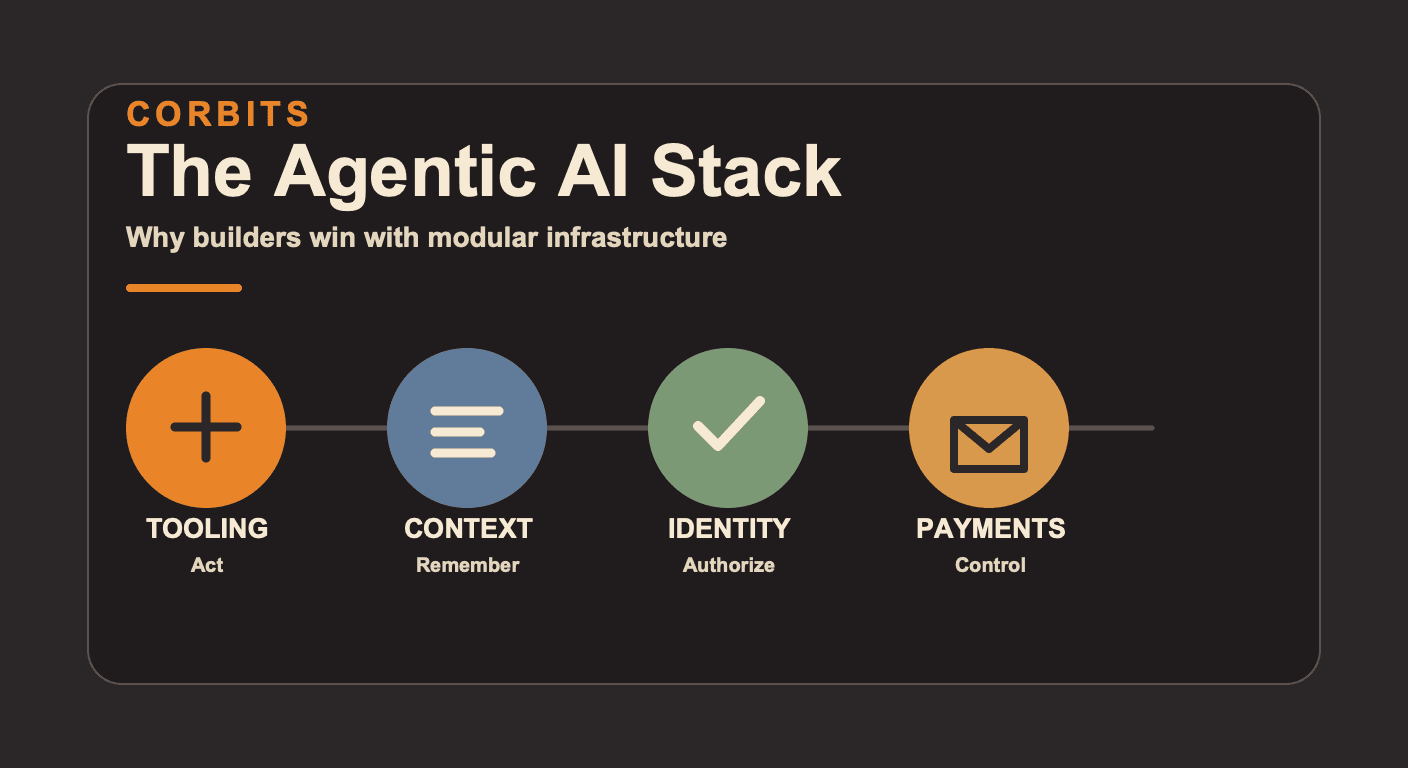
The agentic AI stack is the set of systems that lets an AI agent do useful work safely. It includes the model, but it also includes the tools an agent can use, the context it receives, the identity it presents, and the rules that govern payment and approval.
That distinction matters. A model can generate an answer. An agentic system can search a database, call a vendor API, make a recommendation, request approval, complete an action, and leave a record of what happened.
As AI moves from chat windows into business operations, the most important question is no longer just, “Which model is smartest?” It is, “Can this system act reliably inside the real world?”
That is why the future of agentic AI is likely to be modular. No single provider can be best at every model, data source, workflow, security requirement, and industry-specific tool. Builders can combine specialized layers into systems that fit the work they need to do.
From monolithic AI to an agentic AI stack
Traditional AI products are often easy to picture: one provider, one model, one interface. That approach works well when the job is mostly conversation, writing, or summarization.
Agents are different. They need to move between systems. They use APIs, command-line tools, databases, and software services to complete multi-step work. They may also hand work to other agents or humans along the way.
The system is less like a single application and more like a coordinated team of specialists.
Venture investor Nick Grossman calls this kind of modular ecosystem the “Rebel Alliance”: specialized teams building distinct parts of the stack rather than one company trying to own every layer. It is a useful framing, but not a guarantee. Open ecosystems create more choice, while also creating more integration and governance work.
The practical opportunity is not simply to add more agents. It is to connect the right agents to the right tools, under clear rules, with enough visibility to explain every important outcome.
The four layers that make agents operational
Consider an enterprise travel agent that plans an employee’s trip to an international conference. The agent needs more than a language model. It needs a stack that can turn a request into a controlled, traceable action.
1. Harnesses and tooling turn reasoning into action
The tooling layer connects an agent to the systems where work happens. For a travel agent, that might mean a flight-inventory API, a booking system, a corporate-card service, and an employee calendar.
Without these tools, the agent can suggest flight options. With them, it can search approved inventory, prepare a booking, and send the final itinerary to the traveler’s calendar.
Tools should have narrow, explicit responsibilities. A flight-search tool should search flights. A booking tool should create a booking. Each call should make clear what was requested, what changed, and whether it succeeded.
2. Context and memory keep work from getting lost
Complex tasks rarely happen in one step. A flight agent may find an itinerary, a hotel agent may select a room, and a policy agent may check spending limits. Each needs the right state at the right moment.
The memory layer should pass structured facts, not a giant transcript. For example, the hotel agent may need the traveler’s arrival time, loyalty status, approved hotel range, and accessibility requirements. It does not need every sentence from the earlier flight search.
This is where many multi-agent systems fail. A handoff that loses a constraint, evidence, or uncertainty can produce a confident but wrong next step. Our guide to context loss in multi-agent systems explains why every handoff needs a defined state contract.
3. Identity and attestation establish authority
An agent should never be treated as a generic, anonymous user. When it requests a corporate hotel rate or accesses internal data, the receiving system needs to know which agent is acting, which organization it represents, and what it is allowed to do.
Identity and attestation provide that proof. The travel agent might present a scoped machine credential showing that it is authorized to request rates for a specific company and budget, but not to make an unrestricted purchase.
This creates a usable chain of authorization. It also makes investigation possible when something goes wrong: operators can see which identity took an action, which policy allowed it, and which human or system delegated the authority.
4. Payments and commerce put limits around spending
Agents increasingly need to pay for data, services, and completed work. A travel agent could pay a small fee for a local transit route calculation, while staying within a pre-approved trip budget.
That requires more than a credit card attached to an account. It requires clear limits: what the agent may buy, how much it may spend, who approved the budget, and what should happen when a request exceeds it.
Payments should be observable and reversible where possible. The same record that shows a tool call should show the associated cost, approval path, and outcome. For a practical starting point, see our guide to setting an AI agent budget.
What businesses should build first
The agentic AI stack is not a reason to deploy a sprawling multi-agent system on day one. More components create more failure points.
Start with one business workflow that has a clear owner, a bounded outcome, and a measurable definition of success. For example, an agent might prepare a travel itinerary for human approval before any purchase is made.
Then make the operating model visible:
- Inputs: What request, data, and permissions enter the system?
- Processing: Which agent and tool performs each step?
- Outputs: What action, recommendation, or record leaves the system?
- Dependencies: Which APIs, data sources, policies, and approval paths must work?
- Failure points: What happens if data is missing, a tool fails, a policy is unclear, or an action exceeds authority?
This is the difference between an impressive demo and a dependable operation. It gives teams a way to test the system before expanding it.
The builders’ advantage
Foundation-model providers will continue to improve reasoning, speed, and multimodal capability. Those advances matter. But intelligence alone does not complete a business process safely.
The durable value lies in the layers that make intelligent systems usable: reliable tools, well-defined context, verifiable identity, controlled commerce, and operational visibility. Those layers will be built by many specialists, working across an open and evolving ecosystem.
For businesses, the goal is not to bet everything on a single platform. It is to build an agentic architecture that can adapt as models and tools change, while retaining control over data, authority, cost, and outcomes.
At Corbits, we help teams build the agent operations layer around that architecture: the controls and records that make it possible to see what agents did, why they did it, and whether they stayed within the rules.
If you are ready to move beyond isolated chatbots, start with a workflow you can observe from request to result. Then add autonomy only where you can explain, measure, and govern it.
See your agents, govern what they do, and prove it to anyone who asks.