Who Owns Your AI Agent? A Guide to Human Oversight, Accountability, and Approval Gates
Who's responsible for your AI agents? Learn how to assign accountable owners, choose the right level of human oversight, and put approval gates in place.
- AI Governance
- Human Oversight
- AI Accountability
- Agent Operations
It's 10 p.m. Do you know where your AI agents are?
More to the point, do you know who owns each agent? Who's accountable for its actions? And when does that person have to step in?
Too often, organizations can't answer these questions. But it's imperative that they do, because even though an agent can execute tasks autonomously, it can't be held responsible when something goes wrong. Only a human can.
In this post, we'll cover agent ownership, how much human oversight an agent needs, where to put approval gates, and how to build a basic governance framework covering all of these elements.
Who Owns an AI Agent?
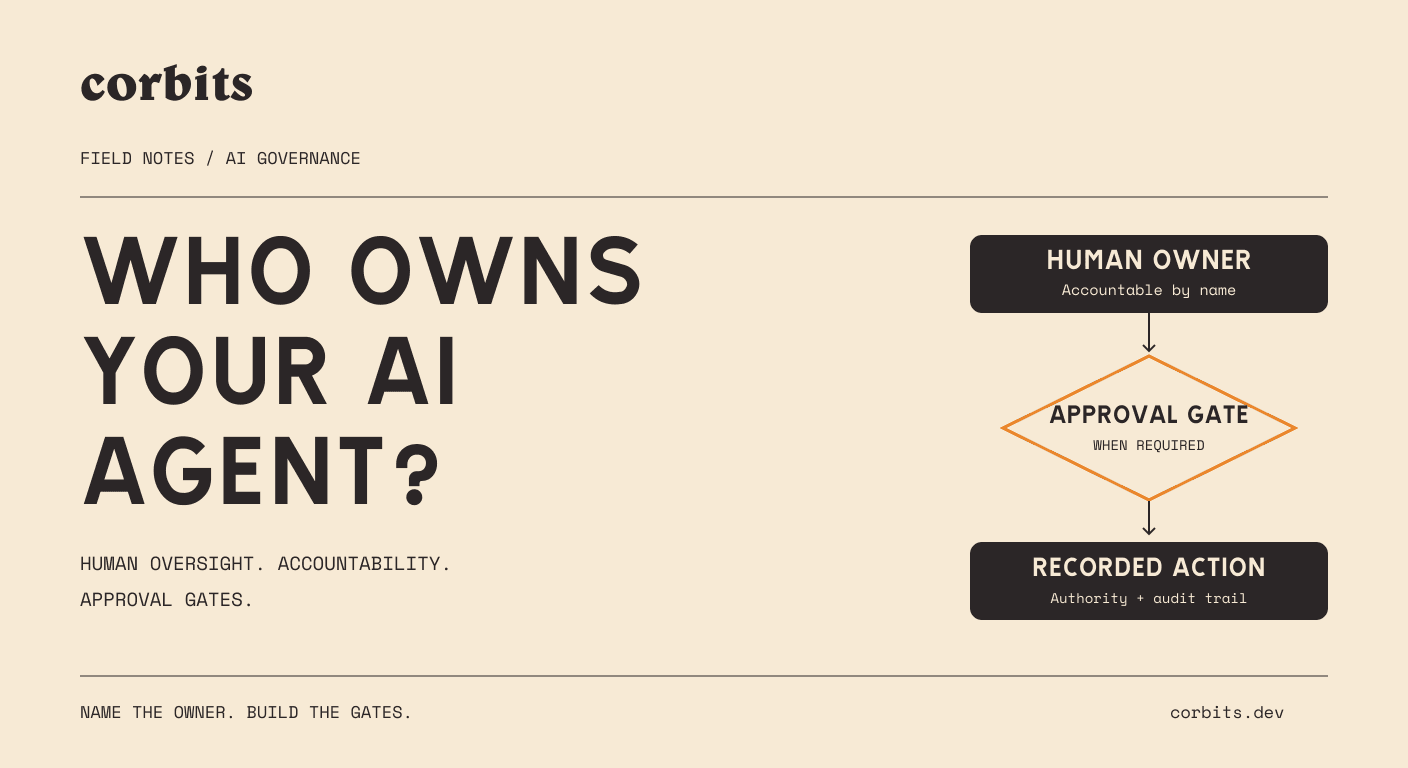
Every agent needs a human owner who is clearly identified by name.
In practice, this may not be so simple. The owner isn't necessarily the person who built the agent, or the one who maintains its infrastructure. There may be different people involved in the agent's life cycle – a security team managing its access to sensitive systems, for instance.
But ownership is where the buck stops. The agent's designated owner must have the authority and resources to oversee its operation, above anyone else who holds responsibility in the agent's life.
Ownership also needs to persist. If the current owner changes roles or leaves the organization, someone else must take their place.
Without clear ownership, agents can become effectively unmanaged. That's how shadow AI happens, leaving no one accountable for the agents and their actions.
What Does Agent Accountability Require?
At the most basic level, accountability requires observability. People can only be accountable for what they can see.
So, for any agent action, four questions need answers:
- What did the agent do?
- Why did it do it?
- Under whose authority was the action taken?
- Who approved it, if anyone?
Answering these questions requires an audit trail that records actions and the context around them. The trail has to be tamper-proof; an agent must not be able to alter it.
Each agent also needs its own identity, linked to a named owner, so actions are attributable. And finally, you need an escalation path for when something goes wrong or requires a human to take over.
How Much Human Oversight Does an Agent Need?
The level of human oversight depends on the action, not the agent itself. Consider how much risk is involved. For instance, an agent summarizing an internal document is less risky than an agent making a purchase or processing a customer refund.
Then there's ambiguity. Is the agent following a well-defined process with predictable outcomes, or is it making high-ambiguity decisions where there's no single obvious answer?
Human oversight should account for both risk and ambiguity. It should also match the consequences of an agent's actions: i.e., the more consequential, the more human involvement is likely warranted.
Here are three common human oversight models and how to choose the right one for your agents:
| OVERSIGHT MODEL | HOW IT WORKS | BEST FOR |
|---|---|---|
| Human in the loop | The agent must obtain human approval at defined risk points or before taking certain actions. | High-risk, irreversible, or costly actions. |
| Human on the loop | The agent operates independently while a human monitors its activity in real time and can intervene when needed. | Moderate-risk, reversible actions with established rules and exceptions. |
| Human out of the loop | The agent acts alone without real-time human involvement, relying instead on hard limits and runtime constraints. | Low-risk, predictable, repeatable tasks that are easily reversible. |
A single agent often uses all three oversight models, depending on the task.
But first and foremost you need to decide when human intervention or approval is needed.
What Are Approval Gates and Where Should They Go?
Approval gates are checkpoints where an agent must pause to get authorization before moving forward with a particular action. They're how you balance agent autonomy with human accountability. The right balance can help you avoid both bottlenecks and blind spots.
To help you figure out where to put approval gates, ask:
- Is the action irreversible or hard to undo?
- Does it cost money?
- Is it visible outside the organization?
- Does it involve sensitive data?
- Could it have legal or regulatory consequences?
Answering "yes" to any of these questions makes the action a candidate for a gate. It's up to you if it warrants one. You might add an approval gate for financial transactions only above a predefined spending threshold, for instance.
But there's more to approval gates than just a simple approve-or-deny button.
What Does an Effective Approval Gate Look Like?
An effective approval gate has clear triggers, designates a specific authority, gives the human reviewer enough context to make an informed decision, incorporates fail-safes, and records what happened.
Let's say you've already defined your triggers – that is, which agent actions require approval and under what conditions. (Be selective! Too many approval requests can encourage rubber-stamping.) You've also specified who can approve what.
Now, you need to make sure human reviewers receive the context behind each proposed action. This includes:
- What the agent wants to do and why.
- What information or policy supports the proposed action.
- What the potential consequences are.
- Whether the action can be reversed.
Then you have to define what happens when an approval is denied or delayed. Should the agent wait, escalate, or abandon the action? No matter what, it should never take silence as consent.
Finally, record every decision for future audits. That's crucial for agent governance.
Build an Ownership and Oversight Framework
Governance starts well before agent deployment. The same way you would define an employee's role and responsibilities, you should be able to give every AI agent a job description that spells out what it can do independently and where a human has to step in.
Follow these steps to set up a basic governance framework:
- Keep a registry. List every agent along with the owner accountable for it.
- Define each agent's authority. Consider responsibilities, permissions, decision-making boundaries, and prohibited actions.
- Tier actions by risk and ambiguity. Assign an appropriate human oversight model to each tier.
- Establish what requires human approval. Place approval gates where called for, and enforce them at the infrastructure level.
- Set intervention mechanisms. Make sure owners can pause agents or revoke access when needed.
- Log everything that matters. Maintain a tamper-proof audit trail of agent actions, decision context, approvals, and handoffs so you can reconstruct how and why a particular outcome occurred.
- Review on a schedule. Verify ownership and confirm that permissions and approval requirements are still up to date.
An AI agent can't own itself. Only a person can answer for it. So name the owner and build the gates… and make sure you always know where your agents are and what they're doing. (Even at 10 p.m.)
Not sure how to put these controls into practice? We're here to help.
See your agents, govern what they do, and prove it to anyone who asks.