
Agent Wallets Explained: How Cloudflare, x402, and AP2 Are Building Payment Rails for AI Agents
Learn how AI agent wallets work and how Cloudflare, x402, and Google AP2 enable autonomous payments with spending limits, authorization, and control.
- Agent Wallets
- Agentic Commerce
- x402
- AI Governance
AI agent wallets let autonomous agents pay for APIs, tools, and online services without a human present to approve each transaction. That's a growing problem for traditional payment systems, which still assume a person is creating the account, entering the card details, and clicking approve. Every step that requires a human is a step where agent autonomy breaks down. And agent traffic is now large enough that some researchers estimate AI agents outnumber humans on parts of the web, a threshold few payment systems were built to handle.
That dependence limits how independently AI agents can operate.
And now, for the first time in history, AI agents outnumber humans online.
But the Internet hasn't fully caught up to this reality yet. Most online services still assume a human is sitting behind the browser... and that becomes a problem when an agent needs to pay for something.
Let's take a closer look at why agent payments are such a challenge, and how a new generation of payment infrastructure is giving agents a better way to transact autonomously.
The Payment Problem: No Wallet, No Autonomy
One of the core value propositions of AI agents is that they can get work done on our behalf without constantly involving a human. But if an agent has to stop and ask a human to create an account, provide ID, enter payment info, or approve a transaction, the human is back in the loop again and again.
This might be fine if you're only dealing with a few transactions here and there. However, it becomes a serious bottleneck when your agent needs to discover and transact with dozens or hundreds of services on its own.
To do that, agents require a way to:
- Identify themselves
- Access funds
- Make payments programmatically
- Spend within predefined limits
So, what's the solution? Enter the agent wallet. It's a mechanism that lets an AI agent do all of the above without human intervention.
Using agent wallets, Cloudflare, Google, and other industry players are building payment infrastructure designed specifically for the agentic web. Here's what you need to know.
What Is an Agent Wallet?
In short, an agent wallet is the financial and authorization layer that allows agents to transact on behalf of humans without being given unrestricted access to funds.
An agent wallet gives an AI agent:
- A way to pay for things online, such as APIs, inference, MCP tools, and other digital services
- A way to receive funds, if applicable
- An identity that can be associated with the human or organization behind the agent
- Programmable spending caps
- Rules about where and how much money can be spent
- An auditable record of transactions
The key is accountability and delegated authority. You're not going to just hand your autonomous agent a corporate credit card and hope for the best. You need hard limits.
That means a human establishes the rules, funds the wallet, gives an agent permission to spend within predefined limits, and takes ownership of the process. The agent then operates within those boundaries.
But before that can happen, the agent wallet needs a payment mechanism built for the way software communicates on the Internet. That's what x402 is designed to do.
x402: Making Payments Native to HTTP
x402 is an open payment protocol built into existing HTTP requests, with no additional communication required. Instead of making an agent navigate a separate account-setup or checkout process, an online service can simply tell the agent that payment is required to access a resource.
Here's how the process works:
- An agent sends an HTTP request.
- The service responds with '402: Payment Required'.
- The agent instantly makes a payment, typically using stablecoins.
- The service verifies the payment.
- The agent receives the requested resource, such as API access.
This way, payment simply becomes part of the normal request-response nature of the web. It's Internet native.
According to x402's documentation, the protocol is designed for agentic commerce, API monetization, paywalled content, and any situation where traditional payment methods are too slow or expensive.
x402 reduces friction, and that makes it particularly useful for AI agents. With x402, an agent can simply pay directly for the resources it uses.
Additionally, the protocol is open source and blockchain agnostic, with support for stablecoin payments across numerous networks. That is, x402 provides the payment rail for other infrastructure to build on.
Which brings us back to agent wallets.
Cloudflare Wallets: Giving Agents a Bounded Budget
Cloudflare has developed an agent wallet framework with two parts: Account Wallets and Virtual Wallets.
Account Wallets belong to humans. They can hold stablecoins, receive funds as needed, and delegate spend to virtual wallets managed by agents.
Virtual Wallets are designed for AI agents and operate via API keys. Maximum spend is capped by the limit set by the owner of the Account Wallet, and the agent can only spend funds according to its permissions.
This system allows agents to make purchases autonomously without gaining access to the full balance of the Account Wallet -- and without requiring constant manual approval.
For further control, human administrators can set guardrails such as:
- Spending allowances
- Approved merchant lists
- Maximum transaction sizes
- Manual override options
These guardrails make it safer to give agents more autonomy and more freedom. For instance, stablecoin micropayments made from Virtual Wallets via the x402 protocol can let agents test API options without an account and without putting larger pools of funds at risk. Even just $10 can go a long way.
Another initiative from Cloudflare tackles the problem of identity. Wallets can be paired with human-readable agent identities through cloudflare.pay. This allows agents to identify their human owner or the organization they represent when interacting with merchants.
So, your agent now has a wallet and a way to spend its money. It may even have a stable identity for merchants to verify. What's next?
AP2: Adding Authorization to Agent Payments
Google's Agent Payments Protocol (AP2) helps answer the next crucial question: "Was this specific transaction actually authorized?"
AP2 provides a framework for giving agents the authority to make purchases while also keeping a verifiable record of what exactly they were authorized to do. It does this through cryptographically signed mandates. Each one involves a different part of a transaction:
- Intent mandate – What the human initially told the agent to buy.
- Cart mandate – The individual items, merchant, and payment details.
- Payment mandate – The authorization info passed to the payment infrastructure.
This creates a chain of trust between the human, the agent, and the transaction. The resulting cryptographic records provide foundational evidence of what was authorized and what actually happened.
And just like Cloudflare Wallets, AP2 uses the x402 protocol as a payment rail. It can support other payment types, as well, like debit and credit cards and real-time bank transfers, but x402 is its primary mechanism.
How the Pieces Fit Together
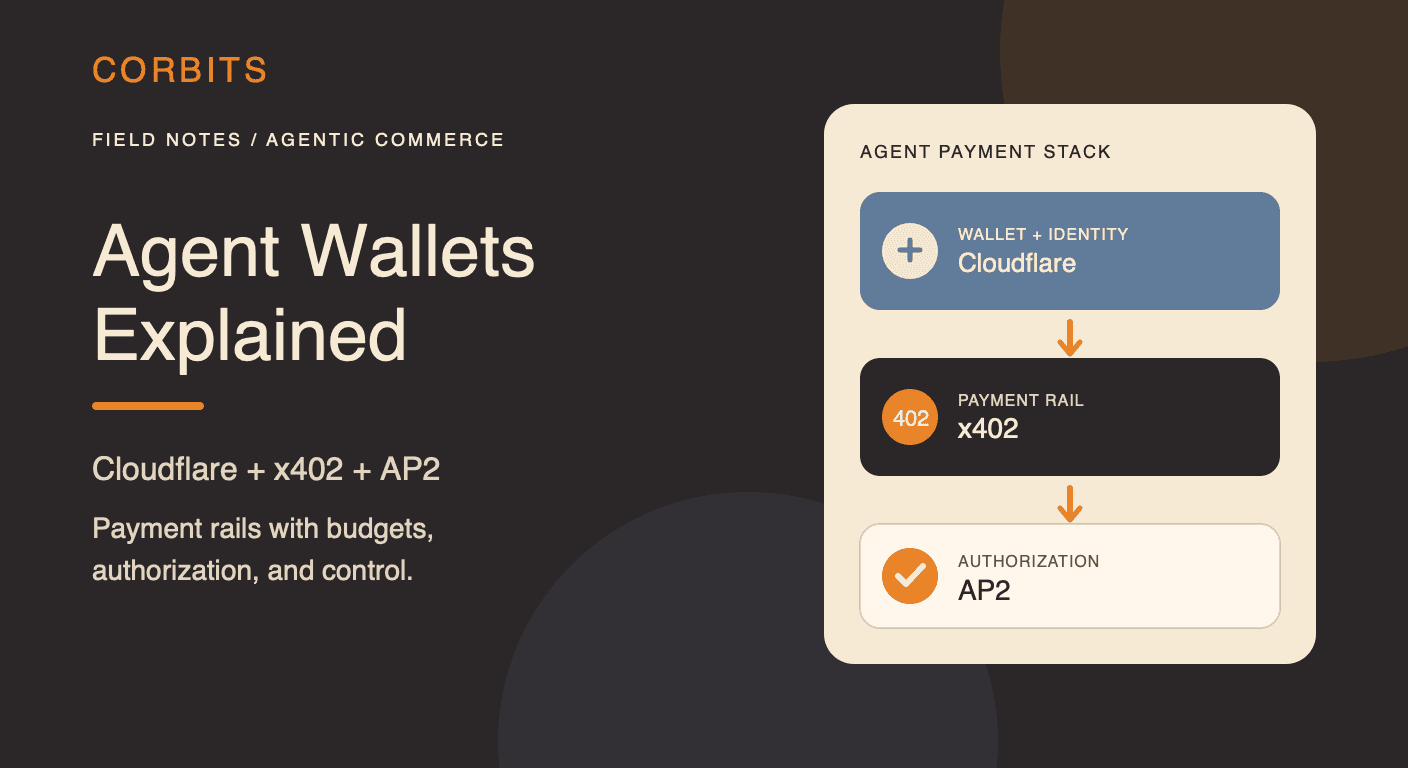
As you may have noticed, these technologies don't necessarily compete with each other. They solve different problems, with some overlap. Here's a quick overview:
| Layer | Technology | Role |
|---|---|---|
| Payment rail | x402 | Lets agents pay programmatically |
| Wallet & identity | Cloudflare | Gives agents funds and an optional identity |
| Authorization | AP2 | Defines what agents are allowed to purchase and records what happened |
The overarching theme is bounded agent autonomy. With these technologies, an agent can discover a service and pay for it entirely without human intervention... while only using funds, identities, and permissions that were established in advance.
Ultimately, that's the biggest challenge: giving agents freedom paired with accountability and control.
Conclusion
As organizations give dozens, hundreds, or even thousands of AI agents the ability to transact on their behalf, they'll need to know which agent spent what money, who authorized its actions, what it was allowed to do, and whether it followed policy in the end. More importantly, they'll need to be able to control it.
That's agent governance in a nutshell.
We're entering an era of agentic commerce where transactions happen at a speed and scale that no human can match. Take away the guardrails, and you've basically just handed a blank check to software you can't control.
You don't want to be left holding the bag. AgentOps is how you can ensure you're not.
Not sure where to start? We'd be happy to help.
See your agents, govern what they do, and prove it to anyone who asks.