
What Is Platform Engineering, and Why Does It Matter?
Platform engineering turns proven delivery practices into self-service paths. Here is why that matters for developer productivity, complexity, and AI systems.
- Platform Engineering
- Golden Paths
- Developer Experience
- AI Agents
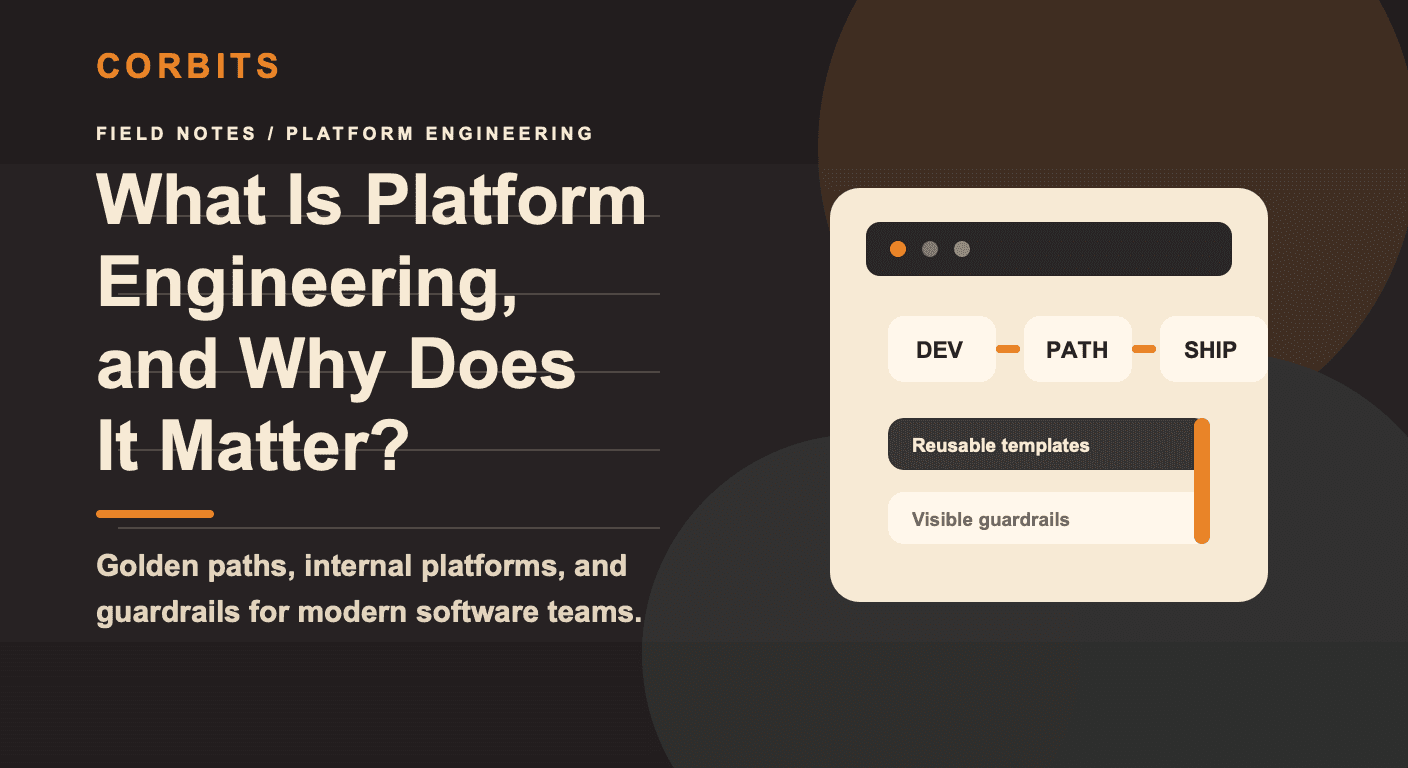
Platform engineering is an approach to software development that helps organizations reduce complexity, improve developer productivity, and standardize how applications are built and deployed. As cloud-native architectures, Kubernetes, and AI become increasingly common, platform engineering has emerged as a critical discipline for modern software teams.
If you were a software developer 15 years ago, you probably mostly wrote code. Today, you may also be expected to understand Kubernetes, CI/CD pipelines, cloud networking, AI tooling, and much more.
But at a certain point, developers who are asked to know everything will hit a wall. As software systems grow more complex, expecting every developer to master every layer of the stack is not sustainable. And you cannot scale that way.
That is why platform engineering exists.
Platform Engineering: Building Better Developer Experiences
It is all about making "the right way" the easy way.
Platform engineering removes friction from software development by designing and building self-service toolchains and workflows that handle much of the operational complexity, so developers do not have to reinvent the wheel for every project.
Or put another way, platform engineering is the next evolution of DevOps. Back in the day, DevOps showed us how development and operations work better together, promoting a culture and practices focused on collaboration and shared ownership.
Platform engineering takes that idea and codifies it: DevOps best practices become reusable, self-service abstractions that the entire organization uses.
Abstraction is a key term here. The platform engineering team builds an infrastructure layer that abstracts away complexity to reduce developer cognitive load. Let us take a closer look at how that works.
The Building Blocks: Platforms and Golden Paths
There are two basic building blocks of platform engineering.
1. The Internal Developer Platform
This is the foundation that makes platform engineering possible. An internal developer platform, or IDP, covers the operational necessities of the entire lifecycle of an application.
One way to think of it: the platform is the product and the developers are the customers.
The IDP provides a portal or interface where developers can access all necessary resources and environments without needing to turn to ops teams or senior colleagues for help, because the platform holds the cognitive load.
Crucially, an IDP does not force every developer to work the same way. If you want to tweak YAML files yourself, you can. Prefer to use a template that provisions everything automatically? You can do that, too.
The platform provides multiple self-serve paths to the same outcome, allowing each developer to choose the level of abstraction that best fits their experience, preferences, and task.
But the underlying infrastructure is never hidden. At some point, every developer needs enough visibility into the full stack of their own services to actually understand it, maintain it, optimize it, and debug what they have built. That is just good DevOps.
2. Golden Paths
In platform engineering, "golden paths," "paved roads," software templates, or whatever you prefer to call them, are self-service templates for common tasks.
According to the Cloud Native Computing Foundation, a golden path is defined as a "templated composition of well-integrated code and capabilities for rapid project development."
So, let us say you have been tasked with building a new microservice.
Without a golden path, you may have to make dozens of decisions before writing a single piece of code. Which repository structure should you use? How should the service be deployed? Which security policies apply? How will you handle observability?
A golden path answers many of those questions for you by providing reusable templates or even automated processes. For instance, it could include:
- Skeleton or starter source code and a getting-started guide.
- CI/CD pipeline templates that handle building, testing, and deploying.
- Infrastructure-as-code templates for consistent provisioning of resources.
- Logging and monitoring instrumentation ready to go.
- Policy guardrails that enforce security and compliance.
- Reference documentation that explains the path and how to deviate from it if needed.
The beauty of golden paths is that they are a proven starting point. You do not have to start from scratch, but you also do not have to sacrifice flexibility. Fork a template, customize it for your needs, and build from there.
But what happens when AI enters the picture? Modern software development was already becoming more complex. The rise of AI has only hit the gas on that trend.
Why Platform Engineering Matters in the AI Era
Beyond the challenges of deploying models and managing AI infrastructure, teams are also now shipping AI agents that autonomously write code, trigger multi-step workflows, and make decisions in the real world. And in the rush to leverage agentic AI, many organizations are repeating the missteps of the past.
What is needed is the same thing platform engineering gave software development: golden paths for standardized deployment, self-service templates, and guardrails baked in from the start. But now that same discipline needs to be applied to AI agents, with centralized controls and real-time visibility into what they are actually doing.
Platform engineering made "the right way" the easy way for software development. It is time to bring that same thinking to AI systems.
Not sure where to start? We are here to help.
See your agents, govern what they do, and prove it to anyone who asks.