The AI Privacy Illusion: Why We Partnered with NEAR AI for Verifiable, Private Agent Workflows
Corbits is partnering with NEAR AI to bring private inference, secure agent runtimes, and verifiable provenance to neoteam workflows.
- Private AI
- NEAR AI
- AI Security
- Agent Operations
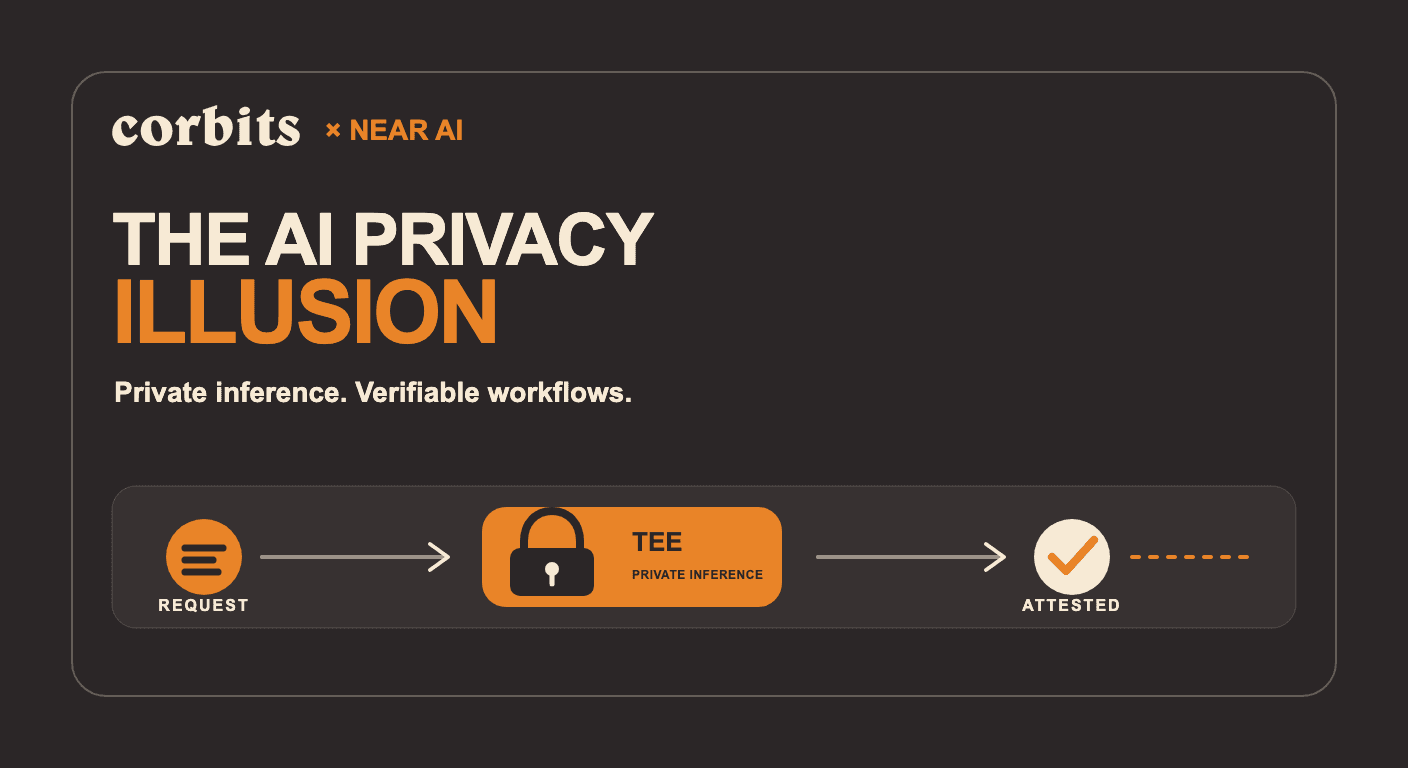
Every prompt your team sends to a hosted AI model can contain sensitive information. Call transcripts, CRM records, internal documents, and customer data may all cross your organization’s boundary when an agent asks a model to do work.
That does not mean every hosted AI service is unsafe. It means privacy depends on controls your team may not be able to inspect or verify.
Stopping AI adoption is not a realistic answer. Agents can deliver meaningful productivity gains. The harder question is how to get those gains without asking security and compliance teams to accept another invisible trust boundary.
That is why Corbits partnered with NEAR AI. We are working to connect NEAR AI’s verifiable private inference and the IronClaw secure agent runtime with the shared workflows and provenance records that Corbits provides for neoteams.
The goal is simple: give teams evidence about where inference ran, what an agent did, and which controls governed the work.
What “private inference” actually means
NEAR AI private inference runs supported models inside Trusted Execution Environments, or TEEs. A TEE is a hardware-isolated area where code and data can be processed without exposing plaintext to the surrounding infrastructure.
NEAR AI provides attestation reports and cryptographic signatures so clients can verify the execution environment and the integrity of an inference result. Its API is also compatible with the OpenAI API specification, which reduces the amount of integration work required to test or adopt it.
There is an important limit. NEAR AI’s model catalog includes both TEE-hosted models and third-party models routed through its gateway. The TEE privacy and verification guarantees apply to models marked as TEE-hosted. They do not automatically extend to an upstream third-party provider.
Private inference is therefore a property to verify, not a label to assume.
Three layers of verifiable agent work
Private model execution solves one part of the problem. A dependable agent workflow also needs runtime boundaries and an activity record that covers more than the model call.
1. NEAR AI verifies model execution
For a supported TEE-hosted model, NEAR AI can provide evidence that the request was processed inside the expected confidential-computing environment. Signatures help detect whether the request or result was changed after processing.
This reduces the amount of trust placed in infrastructure operators. It does not prove that a model’s answer is correct or that an agent was allowed to act on it.
2. IronClaw limits what an agent runtime can do
IronClaw is NEAR AI’s open-source Agent OS focused on privacy, security, and extensibility. It uses WebAssembly sandboxes, capability-based permissions, endpoint allowlists, and protected credential injection to constrain tools and reduce data-exfiltration risk.
Corbits is adding IronClaw support so teams can bring those runtime boundaries into shared, multi-user agent workflows. The agent runtime controls how work executes. Corbits supplies the team-level operating context around that work: organization, permissions, coordination, and visibility.
3. Corbits records the broader workflow
A model signature covers an inference request and result. It does not cover every tool call, approval, handoff, or cost that surrounds that request.
Corbits provenance records are designed to capture that broader chain. They give operators a tamper-evident history of agent actions, including model calls, tool use, and inter-agent messages.
These two proof layers answer different questions:
- NEAR AI attestation: Did this inference run inside the expected TEE?
- NEAR AI signatures: Is this request and result authentic and unchanged?
- Corbits provenance: What happened across the wider agent workflow?
Keeping those questions separate makes audits clearer. It also makes failures easier to isolate.
What cryptographic proof does not prove
Cryptographic evidence can show where code ran and whether a record changed. It cannot tell you whether an answer was accurate, a business decision was wise, or a policy was configured correctly.
Those risks still require ordinary operational controls:
- Choose a TEE-hosted model when the workflow requires private inference.
- Verify attestation rather than assuming the endpoint is protected.
- Give each agent and tool the narrowest permissions required.
- Require human approval before high-impact or irreversible actions.
- Monitor outputs, costs, errors, and policy exceptions.
- Keep a rollback path for every production workflow.
Security comes from the whole system, not one component.
Private AI without hidden trust
Teams should not have to choose between useful agents and understandable systems. But “private AI” only means something when operators can inspect the data path, verify the execution environment, and trace what happened after the model responded.
Our work with NEAR AI is a step toward that standard: private inference where the model supports it, bounded execution through IronClaw, and workflow-level provenance through Corbits.
The result is not a promise that agents can never fail. It is a system that gives teams better evidence, clearer boundaries, and a faster path from an unexpected result to an explainable cause.
See your agents, govern what they do, and prove it to anyone who asks.