
The Great De-Sloppening: Screen AI-Generated PRs and Issues with Corbits Triage
AI agent-generated PRs and issues are overwhelming open-source maintainers. See how Corbits Triage lets you screen the backlog.
- Open Source
- AI Coding
- Pull Requests
- Corbits Triage
Most of us have run into AI slop before. It's a blight on the Internet, from social media posts with that distinctive AI cadence to AI-generated ads with an "uncanny valley" look and feel. You know what we're talking about.
As AI coding agents become more capable and ubiquitous, that same slop problem is now squarely present in the world of open-source software development. Agents can write code, generate pull requests (PRs), file issues, and contribute comments with minimal human involvement.
Their contributions can be helpful, of course. But others are decidedly unhelpful, and someone has to figure out which is which.
It's an indiscriminate slop cannon aimed at open-source maintainers.
When Generating Code Is Easier Than Reviewing It
Open source is built on collaboration. It centers around making source code publicly available for anyone to view and play around with, to tinker and experiment, and eventually to build something better together. There's something almost magical about that.
Successful open-source projects have always relied on contributions from people outside the original development team to help refine the software. But reviewing contributions takes time.
What happens when AI agents change the equation? Within seconds, an agent can:
- Open PRs for anything it erroneously identifies as a bug
- File issues on projects it doesn't actually understand
- Generate plausible-sounding explanations that take time to disprove
As GitHub's Ashley Wolf put it, "The cost to create has dropped but the cost to review has not."
The cURL project actually scrapped its vulnerability bounty program for this exact reason: it was being overrun by low-quality AI-generated reports.
"AI slop is overwhelming maintainers today," cURL founder Daniel Stenberg said. "We need to make moves to ensure our survival and intact mental health."
That's how bad it's gotten.
The PR and Issue Backlog: A Signal-to-Noise Crisis
The trouble with AI slop is that it doesn't always look like slop at first glance.
For instance, an agent-assisted PR can be confidently incorrect. It might fix a symptom instead of the underlying bug, or introduce code that works in isolation but isn't aligned with the requirements or conventions of the repository.
Identifying this sort of thing requires careful review. Every contribution, whether good or bad, has to be read and evaluated before a maintainer can decide what to do with it. But when AI agents can generate PRs, file issues, and post comments much faster than people can review them, even well-intentioned contributions can turn into a serious bottleneck.
Maintainers become overwhelmed, and good contributions get lost among the AI noise. The backlog continues to grow.
So, what's the solution? Open-source maintainers need a way to quickly distinguish the contributions that are worth their time from the ones that aren't.
Introducing Corbits Triage
We built Corbits Triage to address a problem we're dealing with ourselves: the massive influx of agent-assisted pull requests that need to be screened.
Triage focuses on pull-request screening; issues and comments are part of the wider maintainer backlog described above.
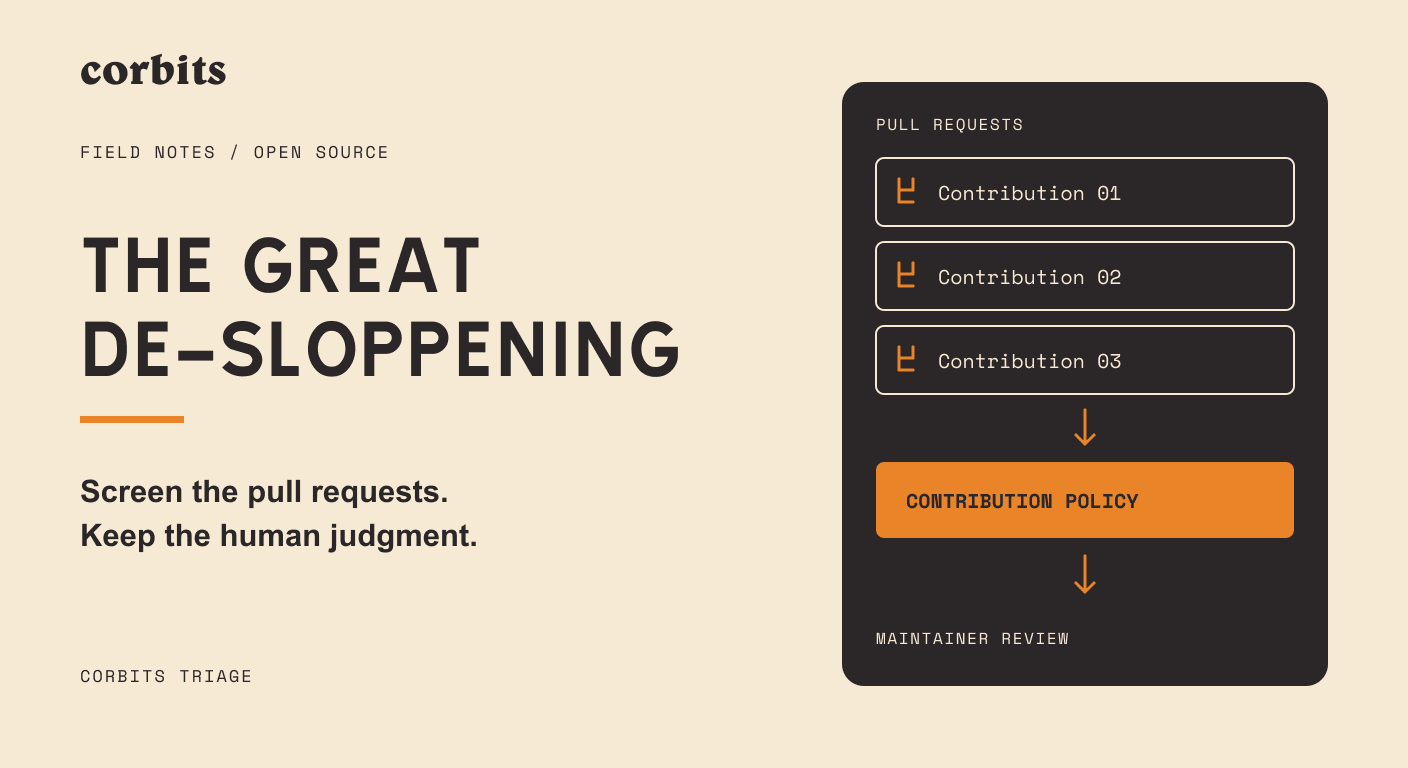
Triage offers customizable PR screening built around your project's own contribution policy. It helps maintainers evaluate incoming pull requests on their own terms, with:
- Project-specific rules. Write your contribution policy as clauses, with each verdict quoting the exact clause and lines of code it applies to.
- Automated checks. Diff size, file count, forbidden paths, and linked issues are checked by machine before the model evaluates the rest.
- Self-provided inference and hosting. Use your own model and hosting, so you control where pull-request data is processed.
One thing is clear. Open-source projects need to preserve the benefits of agentic development without letting the sheer volume of requests overwhelm the people who maintain the software. Screening and triage are becoming essential parts of that workflow.
The slop cannon isn't going away anytime soon. But with Corbits Triage, you don't have to deal with everything it fires. You decide what reaches you.
See your agents, govern what they do, and prove it to anyone who asks.